I'd like to start this one by quoting the Netflix summary of the film. According to the summary "this film [is] about Yolanda, a singer who sells heroin on the side and goes on the lam when a deal goes awry. Now, thugs are after her, and her only sanctuary is a convent where Mother Superior is a junkie, a lesbian and also a fan of Yolanda's. Plus, another nun does LSD, a priest smokes hash, and everything is unexpected."
I've quoted this for two reasons. The first is I find the description hilarious, like it's a description from a terrifying children's book. The second is that, as ribald as it makes the movie sound, it's misleading. Dark Habits is a quiet, sad film that takes the vices of its characters rather seriously, taking time to explore the truths behind these vices, as well as the consequences they bring. On the surface, it may seem outrageous, - a nun does heroin! - but except for the religious component, it's not altogether shocking (or too remarkable, I'm afraid) underneath the gaudy, Catholic surface.
The film's got a nice pastiche of quirky characters that it treats with an admirable respect, but too often it wanders around in search of a point of view. It ends powerfully, with a great jilted lover scene, and there are a few high-water marks like a climactic performance by its main character, Yolanda, but not unlike her character, the movie feels like it's hiding out in a convent, watching things happen, just biding its time until the heat's off. Still, I loved the idea of a nun writing tawdry prose with an assumed name, and I was tickled at the notion of the convent's acid-taking Nun-cook having Jesus-based hallucinations while she prepares the food, and hey, I'm always game to watch a nun feed a rowdy tiger.
The problem in the film lies in the way the Yolanda character is handled. She makes a nice, convincing way of bringing us into this strange, cloistered world, but the movie never embraces her fully, stays away from examining her, and as a result, keeps us, the audience, at arm's length. The film asks a question as to whether or not the world and its inhabitants have changed or are capable of changing, and comes down squarely in the middle with characters on either side. There's nothing wrong with that, and this honesty about difficult questions is part of what makes the movie work as well as it does, but it fails to question the viewer as well as the characters, and that's, I think, what keeps it from taking off.
Wednesday, December 07, 2005
Day 68: Dark Habits


Tuesday, December 06, 2005
Day 67: King Kong (1976)
So, I hope I'm not wrong here, but that was the giant snake from Conan, right? I only ask because both movies were Dino De Laurentiis productions and they looked awfully similar. Maybe it's a venerated line of fake snakes, like the Barrymores, or siblings, like Donny & Marie.
The thing is, aside from Kong, there was only one monster on Skull Island in this version of King Kong, and it was a giant snake. It's weird because, though much time is spent on the island, nothing actually seems to be happening. Jessica Lange spends a lot of time in Kong's hand (I got so sick of seeing that thing) gets washed and blown on by him, he pokes her, she shouts at him, and that's about it. At least in the original, Fay Wray and Kong had a sort-of Stockholm Syndrome thing going on as she depended on him for her survival.
Though, I give the movie many points for trying to answer the question of why Kong would want a human lady friend in the first place. That it goes for the most literal of answers (sex, duh) results in my subtracting most of the points. It does lead to a moment in which Charles Grodin, referring to the fifty-foot ape, tells Jessica Lange, "He was going to rape you," but perhaps the reason that Kong wants human females isn't a question that needs to be answered, literally or not. It's certainly a lot more primal when it's unexplained, a lot more interesting, and allows me to have conversations with my girlfriend where we debate as to whether Kong likes these women as pets or flowers. The movie also does well to show difficulties in transporting Kong to America, but what does it matter since we're all waiting for him to stand on a skyscraper anyway?
This is a vulgar movie, a loud and trashy junk film, with too many fun, dumb elements to kick to the curb, but one that far overstays its welcome in its 134 minute running time. The movie is paced like it was made by snails, despite the fact that there's a lot of screaming, yelling, and crashing going on, and, thus, one can only imagine that these were coked up snails, having just done a line off of a hot snail's slime trail. There's definitely a weird Vietnam hippy-counterculture vs. Nixon voter symbolism-thing going on in the script, but the movie is so unwieldy and everything in it is so muddled, any intended Chayefsky-esque satire is lost amidst the roaring.
The worst, most unfortunate part of the film is the way it handles Kong. I don’t give a rat's ass about how "real" effects seem, or that I can see wires or composite lines. None of that really matters to me as long as the effects are placed within the fabric of the movie well. Despite the fact that the face is well articulated and Kong's personality comes through, the full bodied Kong is uninteresting to watch, held down by his technology, sluggish in responding to anything. Kong's lethargy here is a stark contrast to the vitality and joie de vivre that the original Kong exhibited, and, wouldn't you know it, this typifies the difference between the two films.
Monday, December 05, 2005
Day 66: Ali: Fear Eats the Soul
A marvelous, understated film about an unlikely love affair between an elderly German woman and a much younger Arab man, Ali: Fear Eats the Soul reminds me of why I like movies. The way it's so matter-of-factly and economically shot and cut, it feels like peering into the lives of these people through some kind-of magic, rectangular window. The movie's efficiency never makes it feel so insular that the characters have no lives outside the frame, indeed, that's one of its strengths, but it certainly lends a feeling that the camera has captured the moments that matter, the most important moments in the story of how these two people came to love one another.
They're both residents of a German town, one that seems sapped of happiness. The movie's opening scene takes place in a bar where people are drinking, but seem to find no enjoyment in it. The elderly woman, Emmi, enters, and is regarded with suspicion and reproach. She clearly doesn't belong there, has only stepped in to get out of the rain, and doesn't know whether she wants a cola or a beer. Everyone, Emmi included, looks drained, worn down by life, photographed in such a way that wrinkles and runny mascara defy any notions of glamour.
Among a group of Arabs in the bar, Ali is encouraged to dance with Emmi in order to make her feel more comfortable. He agrees and the two engage in an awkward dance, talk to each other about their lives, connecting on a level of loneliness and a desperate desire for empathetic human contact. When the dance is over, they continue talking, he goes home with her, and stays the night. Despite the fierce racism of Emmi's associates, friends, and family, they continue seeing one another and eventually get married.
These early scenes are inspiring, charming, and almost overbearingly sweet. It's wonderful to see these two lonely souls find each other and rousing to watch them flaunt social convention in defense of their love. The hangover of Nazi Germany is omnipresent (Emmi was a member of the Nazi party and speaks of Hitler in the same reserved, yet non-denouncing way that some former Nixon supporters do) as is the prejudice against Arab people due to the events at the 1972 Munich Olympics. Everyone who disapproves of the relationship claims, "It won't last," and, yet, the happiness that Emmi and Ali bring to each other and the contrasting misery the other people live in is so well delineated, you can't help but need their relationship to last.
For a while, it seems that the movie may be a simple fairy tale about the way integrated relationships invariably produce more harmony between people of different races, but it's got better, more complex, more interesting things to say. The relationship hits a snag when the two no longer have anything to fight against, and both begin drifting apart from one another, returning to the loneliness that brought them together in the first place. It's difficult and frustrating to watch, seeing these two people who once communicated so openly and simply with one another unable to speak to each other. But, ultimately, when the film brings the two back together in the place where they met, the movie's point is that lasting relationships require their participants to reeducate themselves about who they're paired with. It's a beautiful, touching thing to watch, fantastically captured by all involved.
I loved this movie with every fiber of my being. It may be one of my personal all-time favorites, something further reflection will no doubt illuminate. I'll know in a year.
Sunday, December 04, 2005
Day 65: The Wicker Man
The Wicker Man illustrates two things that are becoming increasingly clear to me. The first is that Christopher Lee is really, truly, no foolin' a fine actor, whose typecasting in villainous roles is as inevitable as it is unfortunate. The second is that island cultures are generally depicted, to put it generously, as a bit odd.
When a pious, Christian policeman arrives at a small island off the coast of Scotland investigating the disappearance of a young girl, he's confronted by the insular and Pagan ways of its inhabitants. As he tirelessly seeks out the missing girl, the open sexuality and irrational beliefs of the denizens shocks and offends him. Unmovable in his faith and seemingly unable to understand the notion that there could be different cultures in the United Kingdom of the 20th century, he scolds the locals for taking no interest in Christ. As the mystery unravels, it becomes clear that the locals, led by an effete, charming Christopher Lee, believe human sacrifice is necessary to preserve their way of life, and the noble policeman foolishly believes he can stop it.
Though at first the culturally narrow policeman character, nicely played by Edward Woodward, is as unlikable and unwelcome as a Bush voter at a gay pride parade, by the end of the film, I was surprised to find that I found him much more sympathetic than any of the Pagan islanders. The reason for this is that he's in the minority, as much a victim of religious persecution as a witch in colonial America, maligned solely for being The Other in an insulated society.
Not so much a horror movie as it is an exploration of the necessary consequences of institutionalized religion, the movie begins with the hippie commune feel of Zardoz and, as it progresses, creepily drifts closer to the tone of an Italian cannibal film. There's a great deal of singing and dancing in the film (and a good deal of it done by ladies in the nude), so much so that I thought it was a musical at first. But with the exception of the siren song of the innkeeper's daughter, the singing and dancing are nice expository devices, bringing us into a rich culture. And, boy oh boy, do the musical elements pay off at the end in a strikingly horrific scene. The scene is all the more horrific due to the bright and sunny way it's captured, with very little artifice to hide the brutality.
The movie's a clunky affair overall, with odd, distracting choices in the score and a great deal of awkward staging and editing. There's far too much monologuing at the end, lending it the impression of a bizarro-world Scooby-Doo ending with the villains of the piece explaining their motivations and plans to a solo, outnumbered good guy. But even with these flaws, the movie cleanly explores the clash of two very different and absolutist cultures in a logical, allegorical way and it's got a horrifying gut-punch of a finale that simply must be seen.
Saturday, December 03, 2005
Day 64: The Stendhal Syndrome
A mid-level effort by Dario Argento, it has the ignoble distinction of featuring rape scenes involving the director's daughter, Asia Argento. This fact is only mildly distracting, though, since the film renders her point of view so well. The title of the film refers to a (fictional?) mental condition in which a person is disoriented and overcome by works of art, causing them to hallucinate and even pass out. It's an interesting conceit, used in a similar fashion to the way Vertigo hobbled Jimmy Stewart's character with its titular mental affliction, and yields some wonderful sequences in which Asia Argento is inundated with hallucinatory sounds and images emanating from works of art.
I've liked Argento's films in the past for their beauty. The image from Suspira of a young woman impaled by shards of a shattered stained glass window is as artful as bloodletting in film gets. In addition, I've admired the way his films capture a tone that feels like they're told from the emotional perspective of their killers; there's a certain amount of shameful joy in Argento's gore, a way of depicting death as if it is both exciting and excruciatingly painful or disgusting at once.
This film, while it's exceedingly graphic at times and retains the creepy perspective described above, loses much of the beauty of Argento's earlier efforts. There are a few moments when the imagery pops out, like when the sculptures in an art museum seem threatening due to the way the camera captures them or a scene in which Asia, trying to hide the truth from a friend of hers, is lit in a way that her eyes seem to peek out from absolute darkness, but for the most part the film feels bland compared to the director's previous work. This isn't a problem in and of itself, but something that struck me as I watched it. Adding to the visual muddiness are some early CG effects that, while they're used sparingly, tend to be distracting.
Still, Argento manages to wring some fine, creepy moments out of a plot that, in other hands, would have been uninteresting. Asia Argento plays a cop on the trail of a serial rapist. When her titular mental condition puts her in a vulnerable state, she's kidnapped and raped by the man she's tracking. She manages to exact a brutal revenge on the man, but soon finds that her experiences have affected her mental state more than she realized.
The movie concludes brilliantly; a group of fellow cops attempts to help and comfort Asia --at this point she's a danger to herself and others-- and instead of accepting their offer, she screams for her life. The movie cuts to shots of these helpful men who surround her and they appear to be leering and aggressive. This scene effectively encapsulates everything that has come before it, rendering Asia's point of view to the point that we're on her side, despite the fact that she's killed a couple of innocents. I also liked the way Argento's usual excess in gore led to a satisfying, realistic confrontation between Asia and the rapist. Also, Ennio Morricone proves, yet again, that he can write music just as delightfully overbearing and creepy as Goblin.
All this is good, but the movie's just too long, its pace is too dull, and its plotting too standard in order to be too excited about it. The second half of the movie, which contains some interesting exploration of Asia's character, is taken up by unnecessary and overly complicated mystery elements, elements that don't withstand scrutiny even after we learn there's an unreliable narrator in the room. Certain characters slow the threadbare plot every time they're on screen. And some plot devices are introduced, only to be dropped later. All of these problems are present in other Argento movies and, often, they somehow add to the dreamlike mood. This time, they're distracting.
Friday, December 02, 2005
Day 63: Lenny
The movie opens with a close-up on a pair of lips, pauses, and then begins. It's an appropriate image to begin on, seeing as the movie deals with the power of words, and the lips are as shocking and compelling as a gun barrel pointed right at us.
Lenny is nearly a masterpiece, the ultimate biopic with such a steady, focused gaze and a remarkable point of view that never betrays itself. It's undone only by an ending that feels too rushed, jumping ahead to Lenny Bruce's death too quickly and then ignoring the facts of Lenny Bruce's death to explore the why. Having said this, it's remarkable that it ends on an image as appropriate as the lips that greet us, a single image of Bruce's corpse that adds one final wrinkle of meaning to this story of the man's life.
The movie understands, where most biopics don't, that if you're going to find meaning from one man's life, you have to pick a point of view to watch him from. What's superb about Lenny's point-of-view is that it takes place after his death, intermingling moments from late in his life with earlier moments and showing, through some really delicious editing, how these two points relate, how they speak to each other, and how they affect one another. Combine this with faked, mocumentary style interviews with actors portraying the people in Bruce's life talking about the effect that he's had on them and how they impacted his life at certain crosspoints, and you have a rich, powerful tapestry about, as the movie would have it, a flawed, yet insightful spokesperson for the freedom of speech.
Dustin Hoffman blasts out of the atmosphere with his performance as Bruce, goes to the moon, and comes back to trade rocks. He's freakishly good, impassioned and hurting, a fact no more apparent than in the scene when he attempts to perform while high on heroin. The camera's locked down in a wide shot of the stage as Hoffman stumbles about, unable to string coherent thoughts together, and desperate to be loved. The way it's shot is painful enough for anyone who's had a bad experience on a stage, the unblinking camera watches every mistake as attentively as the audience, but Hoffman's spot-on delivery makes it even more so. After a few unsuccessful attempts at doing his act, he whispers into the microphone a barely audible, "I'm not funny," and walks off.
This is the second Bob Fosse movie I've reviewed for One Movie a Day, and I will say this about his work: he knows how to cut a movie. Even with the vast amount of overindulgences featured in All That Jazz, the movie, like this one, had some powerful contrapuntal moments in the edit. And, here, the cutting works well at aping the style of a Lenny Bruce performance, moving rapidly from one thought to the next and then slowing down to savor a particularly juicy bit. It's effective and nearly maddeningly intense.
I loved this movie. Smart, funny, and well crafted, it vaults over nearly every other biopic I've ever seen and stands out as one of the greatest, most sincere movies about the agonizing futility (and necessity) of fighting a society's fear of certain words with those very same words.
MONSTER FIGHT!
During the car ride to work today, Tara and I continued two discussions we've had in the past. Both are relatively related enough that I feel I should share them.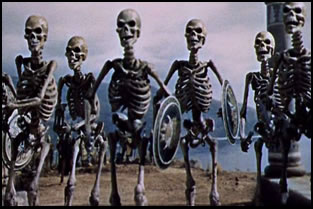 The first discussion was centered on the character of reanimated skeletons, and how, it seems, that these skeletons are all entertainers. It often seems that these skeletons get reanimated because of a greedy lust for life. Think about it: reanimated skeletons are constantly presented as singing, playing the xylophone and dancing rickety, herky-jerky dances in order to scare the dickens out of janitors or trespassers. It occurs to me as I type this that some of them are warriors, but even then they always seem to be delighted about the fighting, like it's a well-rehearsed performance. Not to mention the fact that they always lose. I think they're not so much warriors as they're like the team the Harlem Globetrotters play. And it's such an honor to share the battleground with Achilles! We also questioned whether skletons would ride a bicycle.
We all know they like motorcycles, but a bicycle is a different story. Tara contended that the ones who rode motorcycles were the skeletons we always got to see, in other words, the more successful skeletons, whereas a "normal" skeleton wouldn't be able to afford it. I argued that a bicycle might be too dangerous for a skeleton because, if it were to fall, it would explode into a million pieces. She rightly countered that the same is true for a motorcycle. I conceded this point and we shifted the discussion to where a skeleton might like to live. We decided on basement apartments. 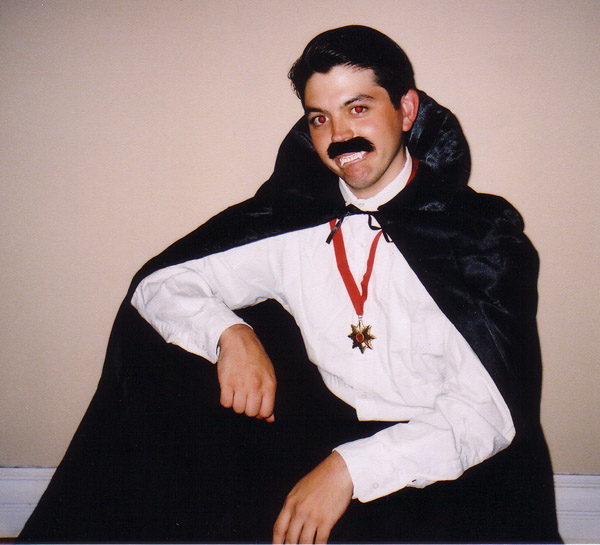
The second discussion was a hotly debated topic as to who would win in a fight between a dracula and a wolf-man. I originally sided with the wolf man because draculas are far too prissy and a wolf-man's raw power would be the decisive factor. However, this morning I remembered that draculas have dominion over some beasts and so would probably have some degree of mind control over the wolf-man. I think we left it that neither one would be able to kill the other, so the end result would be that the two would simply fuck each other up.
Thoughts?
Thursday, December 01, 2005
Day 62: King of New York
Notable for a fun, over-the-top performance by Laurence "Larry" Fishburne, a cool, indulgent performance by Christopher Walken, and some hyperslick cinematography, King of New York is not quite good, but it is an authentic greasy diner at 3 a.m kind-of. junk food viewing experience that is often alluring. The tone of the film shows what a film would be like if Michael Mann, Ridley Scott, and Brian DePalma were fused together in a freaky telepod accident, a three-way Brundlefly of slick, pretty cinematics and unfulfilled arty aspirations, expressed through heartfelt close-ups of violence and tits; a Brundlefly named Abel Ferrara. It's not quite as good as it sounds though. If this were a more focused character drama or a go-for-broke, by the numbers genre film, it would have been awesome, but the movie straddles both worlds unsuccessfully, leading to a pretty, yet scattershot mush.
Walken plays Frank White, a New York drug kingpin returning home from a lengthy stay in prison. He's anxious to reclaim the city's crime scene from those he feels are unworthy to carry the torch, motivated by a newfound sense of altruism. White's big plan is to fund a hospital in a poor neighborhood with his drug money, and he wouldn't mind taking out the other drug lords who, according to him, unnecessarily exploit people while he does this. Meanwhile, a group of cops led by David Caruso steam and fume over his release, lament his wealth from a life of crime while they barely make do with their miniscule salaries.
A wonderful moment, albeit one of easy sentiment, occurs about three-fourths of the way into the movie. Walken, in a dingy underground tunnel, orders the death of the squealer. He walks to the exit of the tunnel and stops, staring out at the city he loves. The camera stays behind, observing him from within. It's a beautiful moment, capturing the way the lifestyle Walken is leading holds him back from realizing his dreams for New York. It's the stuff of every gangster movie in memory: the desire to leave a corrupt and failed system to do some real good, but being unable to do so. It's quiet, poignant and thoughtful, and the movie could do with some more of this kind-of filmmaking if it had anything it wanted to say about White's misplace altruism.
But, then there's all the shooting. The genre beats, the shoot-outs, and the squib explosions are all accomplished bits of filmmaking in their own right. I admired the way some of the death scenes in the movie were played by the actors as extensions of their characters, not simply "I am dead now!" moments where they'd get shot out of the plot. And I particularly enjoyed the way two out-of-focus background bums watched a climactic shootout. A long car chase with shooting on the wet, rainy (and bridgey) streets of New York is well handled too.
So what's wrong here? Frankly, Walken dances a little too much (blasphemy, I know. It should be noted, though, that there's a classic buildup to a Walken monologue near the end.), the script focuses on certain story beats for much longer periods of time than they deserve, and the film's conclusion is a muddled riff on the reflexive nature of power and violence. You know, the old live by the sword, die by the zzzzzzz, huh, what? Oh yeah. The editing is also all over the place; the movie never really finds a narrative a groove until sometime in the third act and this groove is quickly discarded. So, despite the excessive and vulgar tawdriness at times, King of New York is not great, kinda fun, and better than McBain.
Wednesday, November 30, 2005
Day 61: The Leopard
There's a certain shame that comes from not understanding the context about which a story is told, a shame that sometimes inspires a reticence to admit the ignorance I have. The Leopard poked at my ignorance over and over during its running time, detailing events that, to me, might as well have been about ancient Martian political insurrections and aristocracies run amok. I found this excruciating.
The film is, on its surface, about events in Italian history, specifically events in Sicily (you know, the place with penetratingly sweet sherberts), and I'm still not entirely sure I understand the historical aspects of the film (the shame). My loss. The events depicted are gorgeous, beautifully shot and thick with period pageantry. This is so emphasized in the opening, with depictions of a wealthy, aristocratic family run by Burt Lancaster and some revolutionary fighting in the streets, that I feared I might be in for an Italian version of Gone with the Wind, only without the context to get why this terrible war was being fought in the first place. Not so.
What The Leopard is about is the passing of one age to the other, from monarchy steeped in beautiful, yet restrictive, traditions, to the ugly rabble and freedom of a people-run state. This passing is personified by Burt Lancaster as an aging prince, forced by circumstances to compromise his principles in order to preserve his way of life. His era and its way of dealing with power are contrasted sharply by Paola Stoppa as a stumbling, ill-mannered rube, a man lucky enough to have acquired such wealth as to be a force to reckon with in this new world.
I've written about how this movie angered me on first viewing. Not having the proper context surely played a part in that. If I were a history buff, I'm sure I'd have been delighted to see history written with such lightning. Instead, I was confused, displaced, and irritated that the movie didn't help me along by setting up the historical context (I can be a dumb American too) more clearly. But even with this crankiness, there was no mistaking the brilliance of the ballroom sequence in this film. It goes on and on as people dance and Lancaster stomps about, tired, worn, and saddened by the death of his way of life. It's superb on every level and hits its height when the old prince dances with Claudia Cardinale, a dance that gives him one last chance to be a true dashing prince and not the withered old man he really is.
The Leopard will stay with me for the rest of my life, this much is certain (and not just for letting me know about the penetrating sweetness of certain sherberts). The images in it are stark, sharp reminders of how beautiful cinema can be, and the weary, oppressive tone is a brilliant, grim counterpoint to this beauty. Despite my first impressions, I'm beginning to think it's one of the better movies about aging and dying, making the personal aspects of aging political and the political aspects of worn-out regimes personal. Still, I do wish to see it again, preferably in five or ten years so that the first impression will have faded some. Maybe it's just an indulgent, pretentious stew after all. I can't say right now. I'm still in love with the last shot of the film.
Now is that Gratitude? Or is it really love?
So, after reading the comments on yesterday's post, I've decided to set up a spinoff blog at the end of the year. I imagine it will be more "bloggish" and will probably detail my aborted attempt to get into shape with such clarity and detail as to add, by its existence alone, another five pounds to my ever engorging waistline (are you with me ladies?). I'll be sure to post a link when it's available.
Thought this Pinky Violence collection thing looked interesting.
last night, I watched The Leopard. It was one of those rare occasions where I feel as if I need to watch the whole thing all over again, no small feat. It's not that I didn't "get it" or that I was confused by it, per se, but the movie ended in such a way that I realized it had been a completely different movie than I thought it was while I was watching it. Watching this three-hour movie was sometimes a chore. For the first hour and a half I was angry at it, frustrated by the giddy attention to period detail. By the 2 hour mark, I was even angrier, since the movie seemed determined to be as free of direction as some misguided people apparently think L'Avventura is.
At about two hours and eight minutes (if I remember correctly), an unintentionally funny line made it impossible for me to continue for at least five minutes. The main character is talking about the character of Sicilians, how it's so lugubrious and yet sensual... as examples he provides knifings, shootings, and then offers "the penetrating sweetness of our sherberts..." Wow. How bizarre.
Anyway, the movie ended and I was suddenly taken with it, even though for most of its running time I was angry, angry, angry. When this happens, it's usually a signal to me that I need to watch it again, if only to be sure that my anger was justified. Sometimes movies just end well, despite middling beginnings, but other times, I've just been completely wrong about what the movie was doing the whole time and my anger is just that of a spoiled brat not getting what he wants from his entertainment (I'm sorry about what I said, Rushmore) But then the idea of sitting through something that made me as furious as parts of this movie did isn't exactly a pleasant thought. Of course, the notion of being able to appreciate something beyond my preconceptions is. Hmm, does this count as a review?
Tuesday, November 29, 2005
Day 60: The Hitchhiker's Guide to the Galaxy
Way overwrought and unbelievably frenetic, The Hitchhiker's Guide to the Galaxy scores a few points by nailing the tone of the Douglas Adams book every so often. When it hits these cheeky, witty high points, one can see an inkling of a very good time to be had. However, the movie buries these moments by blistering along at a pace not suited to the material and screaming jokes that would clearly work better as offhanded remarks.
It's frustrating when a movie ends up like this. The design is pretty cool (love those Vogons), the actors are game, and the script, while lacking, isn't bad. The movie undermines these elements, running them through a blender of hyperkinetic filmmaking resulting in a pile of mush. Martin Freeman is well cast in the lead role of Arthur Dent (I would give him an award for "best reactions to imaginary objects composited in later), but I never felt as if I had a chance to know his character, and his character never had a chance to cut through the muddle.
Whenever the movie cuts to animated sections from "The Guide," there's a stillness that allows the jokes being told to actually take hold and be funny. Whenever the movie is dealing with live action folk, though, it seems to think it's a parody of the Star Wars prequels or Lord of the Rings, mirroring the hyperkinetic tone of the former and the overly sentimental majesty of the latter. It's not as if these jokes don't deserve to be told, it's just that they demean the plot of the movie we're watching. It leaps from farce to honest storytelling without these aspects ever coexisting in a way where one informs the other or, at least, coalescing into a spicy jambalaya.
The most telling example of the movie's mistaken tone is a scene where the movie delves into Adams's famous answer to "life, the universe, and everything." We're shown a collection of super-intelligent pan-dimensional beings that have built the computer that can calculate the meaning of life, gathered to hear said meaning. They're partying like it's Mardi Gras, and that's… okay, I guess, not really funny, but it makes sense, sort-of… but when the computer is about to reveal its answer, the movie keeps artificially heightening its tone: the camera cranes up the supercomputer to reveal the multitude of beings, the score builds and builds, and, all the while, even if you weren't familiar with the book, you'd know there's a joke about to be told. This telegraphs the joke in such a way as to cheapen it, castrate it, and destroy whatever chance it had to be funny.
This happens a lot in the rest of the movie, this overindulgent, in-your-face jokesmithing, and it sucks most of the wit out of the script. That's nothing to be said of the ridiculous pace of the movie. The movie is in such a hurry to hit its plot points, it often feels like you're taking a tour of the Parthenon and the tour guide is constantly pushing you through it as fast as the two of you can go, all the while screaming into your ear to look at the important stuff you're missing. It's disappointing, because there are a few good moments in the movie, mostly related to the Guide, that indicate potential goodness. Otherwise, it's a noisy, overbearing mess.
Too tired to die
I've been swamped, too busy to post anything other than my nice reviews. And by nice, I mean, somewhat lacking.
Anyone have any thoughts as to what should happen here after January 1st? Should this site sit, unupdated, collecting dust on the shelf of Internet antiquities? Should I post randomly? Anyone out there want to take up the challenge of one movie a day for x months?
Monday, November 28, 2005
Day 59: King Kong
Years ago, I was in a book store and saw a children's book version of King Kong. It was a simple retelling of the tale with illustrations and, aside from the fact that it told the same story, it never referenced the movie. It just was, Kong as mythic a creature as the Big Bad Wolf or Rumplestiltskin, a fable about the hubris of man versus nature or the explosiveness of rage. It was then that, though I was a stop motion nut, King Kong really began to excite me. I realized that Kong is one of the first, if not the first, filmic myths, myths whose origins began when the lights went down in some movie theater somewhere (I'm hard pressed to come up with another one right now, though I think Freddy Krueger might be another example of a purely filmic myth). So, while I loved the idea of Kong as much as Kane loved the idea of his past, every now and then I'd remember that I had never actually sat down and watched the whole thing from beginning to end. As a kid, I'd watch bits and pieces of it when it came on TV, but I had a short attention span back then and had trouble accepting anything in black and white. So this was, I believe, my first viewing of King Kong from beginning to end, though I'd probably seen the entire movie in chunks prior to this.
And, finally watching it, I realized why it was a myth that refused to die and why children still know through cultural osmosis about Kong atop the Empire State Building (how many know about Mighty Joe Young's fight with lions?). King Kong is made of the same stuff as the Grimm Brothers' Tales. It's got the logic of a fairy tale (particularly when he randomly climbs up the Empire State Building) and whatever the moral of the tale is, it's delightfully obscured by the sheer narrative of it all, slim though the narrative may be.
I don't have anything to say about it that hasn't been said to death, but while watching it, I was tickled to notice that every single time Jack Driscoll showed affection for Ann Darrow, something Kongish would happen. He tells her that he loves her on the boat and then she's whisked away by the "primitive people", given over to a hulking monstrosity of pre-human (read: id-like) impulses. He puts his arm around her in New York and the same giant bundle of animal instinct breaks free! He comforts her in a hotel room (I mean, a hotel room, wink wink, nudge nudge) and Kong breaks through the window with a giant furry appendage and takes her away. Is Kong simply a hyper-Freudian manifestation of Jack Driscoll's repressed sexuality? Why not?
There are a bazillion reads on Kong (including the "miscegenation read," something I leave to better folk than I). And I take that as evidence that it's the stuff of myth, the stuff of enduring folk tales. Like Dracula, Frankenstein, or the Wolf Man, Kong is a manifestation of something primal, something dangerous, but also something loveable. The difference between these other monsters, though, is that Kong is a direct result of industrialization. He's a natural warning about how, as we build our buildings bigger or have the ability to take to the sky, there's a danger that grows in accordance with this "progress." Strangely enough, the threat looks a lot like we do, represents our evolutionary past and, god dammit, when it dies, everybody gonna cry. Of course we cry. He's a symbol for everything we've lost or left behind in our development as a species and we have to slaughter him if we want to continue developing.
Sunday, November 27, 2005
Day 58: Monsters Crash the Pajama Party
Something Weird Video has put together a phenomenal disc here. The subtitle is "Spook Show Spectacular" and the way the DVD's laid out provides an excellent context for viewing Monsters Crash the Pajama Party. The movie was part of a live show and, as the movie played, actors would emerge dressed as monsters to terrorize the audience. The disc is laid out with no clear indication as to what the buttons on the menu will play and, so, clicking around will net unusual results. (After playing around, I found an entirely separate feature entitled The Tormented, but having subjected myself to so many random, kitschy, spooktacular images by exploring the DVD, I thought it best to leave this flick for another day).
Monsters Crash the Pajama Party is, as a movie, awful, just awful. The titular monsters are really just a guy in a monkey outfit, though there are some other people made up like it's Halloween, and a mad scientist. Some girls spend the night in a haunted house for a sorority initiation and are harassed by the monster and scientist, as well as some guys. It's perfect if you're looking for one of those confused, hilarious movie experiences at 2 a.m., and would be good fodder for training MST3K wannabes if the movie itself wasn't constantly throwing in meta-jokes about its own awfulness. It's all in good fun, though, and great viewing if you're a lover of esoteric entries in campy juvenile horror from the 60s (which I am).
Anyway, it's only about thirty minutes long, including a seemingly interminable credit sequence in which men in monkey suits embody the role of director, producer, composer, editer, etc. The real treat is finding the goodies on the disc and trying to decipher meaning, any meaning, from them. So, the movie's very, very bad but it's wonderfully presented, just as it undoubtedly was during its original theatrical run.
My favorite part of this DVD is the first thing that plays. It's one of those black-and-white circular rotating hypnotic images and a voice says some of the following over four minutes:
"…you may feel yourself changing, from the gentle person you are, to a monster with dark green blood running through its veins. Or you may change into a werewolf with long fangs for teeth. Or you may become a vampire with a deep urge within you for a refreshing drink of blood… warm human blood.
Of course, these changes will happen to only a few of you, while others will remain as themselves, in a way. In a strange sort of way. And some may notice a feeling of loneliness and have an urge to run far into the darkness, to the nearest cemetery, to be in the company of the other souls who walk in the night. Some may imagine they feel long bony fingers clutching at their throats. If this should happen to you, don't move a muscle. Don't make a sound. Don't even breathe. Just cross your fingers as a cross usually protects you. If not, you will have the time of your life. The last time.
…Or you may feel other things, things without shape of any kind, yet you know somehow that they are very close to you. You may feel something crawling all over your body that leaves cold damp impressions on your skin. And some of you may feel your hands tingling a bit here and there. Don't be alarmed, these are the friendly ones. The only friendly things you'll feel during this night of terror. I leave you now in a trance of enjoyable hallucinations of the horrible things in store for you."
Saturday, November 26, 2005
Day 57: Shopgirl
Worthwhile, though far too mawkish at times, Shopgirl's a sweet, affecting movie about a young woman living in L.A. She's kind-of an artist, works at Saks, and can barely afford the minimum payment toward her student loans. The movie focuses on two relationships in her life, one with a scattered, aimless young man and the other with a wealthy, classy older man. The movie indulges in too many saccharine-laced montages, or too much awkwardly used slow motion when it should be getting deeper into the nitty gritty of its characters (something it does well otherwise) and narration is used in an inconsistent, clumsy way to fill in details. However, it's quite thoughtful and exceedingly sincere, and for all its sappiness, it's this sincerity that saves it from ruin.
Claire Danes is wonderful as the main character, nuanced and realistic. It's a well-observed performance, one that seems tailor made for her skills as an actor. Unfortunately, in the role of the older man, Steve Martin, while not exactly bad, seems more aloof and embarrassed than his character warrants; his is a shy performance, one that at times is fantastic, but at others feels far too shallow or reserved. His work as an off-screen narrator is great, though, and this is no surprise since he wrote the book the movie's based on. Playing the young man, Jason Schwartzman is a scream, though he's playing the part a lot more broadly than the other two so, at times, he feels as if he's from a different movie. (This feeling is enhanced by the fact that Schwartzman is often framed in a shot by himself, talking to or reacting to someone off camera, lending the feeling that he's doing a one-man show that happened to be inserted into the film).
I was quite impressed with the way the movie used clothes. It's not that clothes play a very prominent role in the diegesis of the film, but the way they were used to define and develop character was compelling. It's interesting that both men are drawn to Danes in clothing-based environments (Schwartzman at the Laundromat, Martin at Saks) and, as her relationship with Martin inspires a new kind of happiness in Danes, the outfits she wears (outfits he can afford to buy for her) are presented as the most prominent evidence of this change (not to dismiss Danes's performance in the role; in fact, it's also due to how she wore the changing outfits that I noticed this aspect of the film at all). Wardrobe is something I usually pay the least amount of attention to in a movie, and this felt like a nice primer in how it can be used to reveal, develop, and enhance a character.
The movie takes too many of the moments mentioned in the first paragraph to give it an unqualified rave, and yet its tone is compelling. I enjoyed the way it veered from the lunacy of Schwartzman's character to the quietude of Martin's and I liked how Danes's problems (which, really, don’t amount to a hill of beans in this crazy world and all that) were dealt with seriously, though never indulging in histrionics (she's not going to kill herself over either of these guys, she just wants to be happier). And I loved the set decoration here too; it was just right in all cases. Danes and Schwartzman live in very similar apartments, but what they choose to do with the space reveals more than thirty minutes of dialogue between the two could. It lacked only a little more dramatic "oomph*" to push it from being a movie I liked a lot to a movie I loved.
*dramatic oomph: Aristotle called this the finest of all things, though he could never quantify it with words, really. He just told me once that the thing he liked most about drama was its oomph. I nodded politely and sipped my tea, waiting for him to leave so I could go to bed, but he wound up talking for 2 more hours about the nature of dramatic "flat-itude" and how it led to a lack of "dramatic oomph." Eventually he left because he had to feed his goldfish and I vowed never to invite him to one of my parties ever again.
Day 56: The Time of the Wolf
A lot of apocalypse movies focus on "survivors," people who size up the situation and find that there's benefit to be found in the destruction of society. Watching these industrious folk take advantage of the freshly wiped societal slate to build their version of a utopia (Dawn of the Dead) or maybe survive through brute force and manipulation (Mad Max 2 & Beyond Thunderdome) is always pleasurable. It allows one to project themselves into the scenario and conjure up a wistful world where survival seems, for some reason, simpler than a world where you have to go through endless loops to achieve the means to convince the guy at the store that he benefits by giving you a bag of marshmallows (this is usually done with currency, a form of communication that allows us to buy CDs without dragging a prize cow into the store).
The Time of the Wolf is an apocalypse film of a different flavor, though it contains many of the same trappings of other films of the (sub?)genre. It reminded me of Testament at times (a movie I saw at the height of a delirious fascination with nuclear weapons and one that I could subtitle for myself: how I learned to start worrying about the bomb) with its bleak and unrelenting outlook on how humans behave as society crumbles. And yet, though the movie contains familiar plot devices like the characters not knowing exactly what is going on, the struggle for resources, or the paradox that the safety found in numbers can be, at times, a perilous one, the movie jettisons the familiar concept surrounding "survivors" in the face of danger and instead features a group of social animals known to some as "humans."
It's well written, insightful, and naturalistic throughout, so much so, that any degree of familiarity I might have felt was replaced with anxiety. The movie's an anxiety-laden endeavor, never ebbing enough to make one feel comfortable (and any time you might think that it's about to, it ratchets up the intensity). This is the case from the beginning to the end. It opens with a nuclear family arriving at a home in the country, starting to unpack the car only to be held at gunpoint by another desperate family and ends with the little boy from this family about to jump into a raging fire. It's not, exactly, a pleasant experience, but then, in retrospect, because it's so spot-on in its observations, this is one of the few apocalypse movies I've seen that actually gives me hope for my own survival.
The novelty of the movie is that it presents an argument that, in the absence of all the security we're used to, there is safety to be found in numbers, though it comes with a price. Certain notions of justice and retribution must be either discarded or dealt with differently than we're used to. Two scenes in the movie feature a person in the group of survivors (note the lack of quotes to protect myself from charges of contradiction) accused of committing a crime, a crime that offers up no external proofs and are quickly reduced to "he said/she said" argumentation. The group, which has no de facto leaders (though some people do step into that role when they feel it's needed), decides there's nothing that can be done about these perceived crimes. The matter is dropped out of necessity: punishment would only increase tensions, thus making it harder to complete what's needed to survive.
As more people get involved, the group of survivors evolve a social structure that reminded me of the social habits of chimpanzees (or, to be fair, my idea of the social habits of chimpanzees; I'm only glancingly familiar with chimp life). Conflict breaks out between them, is resolved through the most resource efficient means, and on they go… busying themselves with their day-to-day necessities. When a young boy is rightfully accused of stealing, he's ostracized. Though the boy is given a chance at redemption, he knows he can never fit into the group again, stigmatized as he is. And yet, he still hangs around, stealing from the main group when he has a chance because they're his only reliable source for survival.
Technically, this is a first class operation all the way. A scene where the main characters are plunged into darkness and lit only by the quick flame of a lighter or by burning hay is particularly resonant. And all aspects of the movie are geared toward a type of naturalism that gives it a welcome legitimacy. The realism only adds to the underlying tension in the movie's plot, a tension so great, at times I felt like I might vomit. And yet, the tension, the uncomfortable anxiety… they exist because of the accuracy in depicting human behavior and it's in this accuracy that the movie's hope lies. So, even with the near-vomiting feeling, The Time of the Wolf is the most heartening, comforting movie I've ever encountered about the destruction of everything that keeps us safe from one another.
Thursday, November 24, 2005
Day 55: The Celebration
Before I begin, I'd like to note that someone clicked on a link to this blog after Googling the phrase: what general belief about pride and prejudice are the makers of this film version trying to dispel and/or what interpretation are they putting in its place? In answer to the question without having seen the movie, I'd venture a guess that they're trying to dispel the belief that pride and prejudice are bad things and that the interpretation they're putting in its place is that Donald Sutherland is, in actuality, a mushroom. Just a guess.
It was a deliberate, cheeky choice on my part to watch this movie with the intent on reviewing it today, Thanksgiving 2005. I confess to finding the whole thing superbly ironic that, on a day when most Americans are gathering together with their families to make merry and consume, I've got to write a review about this particular movie. And, while The Celebration is a movie about the nature of family and asserts the power of the family group, it's certainly not a feel-good reinforcement of the safety found in the warm embrace of one's family. If you're looking for something like that, I'd direct you to Jurassic Park or Mrs. Doubtfire. Now leave us alone.
The Celebration is one of the Dogme films, Dogme '95 being a movement to strip the artifice from movie making in favor of filmmaking with a more direct, improvisational spirit. It's a harsh, pointy movie in every way, from its splotchy, grotesque video, to the way it unravels the truth about the family in question. The setup itself is confrontational: a large family gathers to celebrate the father's sixtieth birthday and the oldest son, Christian, uses this opportunity to level allegations of sexual abuse at his father.
But what happens after he speaks up is unique and honest. The family barely bats an eye, unsure how to take the charges, whether as a joke or something serious to deal with. They continue their gaudy meal and Christian, only slightly deterred, continues to bring the topic up. After dealing with this for a certain amount of time, the family rises up against him, throwing him out of the birthday party so that they don't have to put up with his disturbances. Even still, he's not done. The movie milks the situation for bleak humor at every opportunity. Everyone wants to enjoy the party, they want to be polite, but they're unsure how to react to Christian.
I enjoyed the way the movie depicted a family circling its wagons against a perceived threat, both at the beginning of the film and at the end. And the style of the film is absolutely perfect for the material; jittery hand-held camera shots capture the intensity of the narrative, but the movie also knows when to be still. Ulrich Thomsen, as Christian, is magnificent. His blue eyes are both dewy and steely at the same time, and, accordingly, he plays the character as a man deeply hurt, but possessing enough inner strength to deal with his pain.
It's an angry movie, rife with confrontation and rage. It's well acted and well produced, even under the strict Dogme requirements. But, though it's so bleak, it's, really, a heartening testament to the notion that families protect themselves against anything threatening. Even when the threat comes from within their own ranks, the movie's point is that they'll adapt in order to flush the intruder out. As such, it feels as much an observant, character study as it does a film about biology, about the way the survival of humanity is so dependent on social structures and the safety net they provide. For this reason, despite the rancor and screaming, it inspires far more comforting thoughts about the way families work for people than anything Chris Columbus has made.
Wednesday, November 23, 2005
Day 54: Cold Comfort Farm
Flora Poste's parents have just died (she wasn't close to them) and, as an aspiring writer, she wants to spend the next thirty years of her life accumulating life experiences that will enable her to write a book as good as Jane Austen's Persuasion. Her inheritance is paltry, though, and she is, thus, forced to confront the most important question all young aspiring artists face: How will I eat?
Luckily, she's offered a room on a farm owned by one of her distant relatives who, due to some mysterious goings on in the past, feels as if she owes a great debt to "Robert Poste's child". Flora, seeing this as an opportunity to gain some insight into the world, sets off to Cold Comfort Farm where she's confronted with a plethora of miserable, grimy characters living under the sway of a mysterious, traumatized matriarch. Refusing to succumb to their gloomy way of life, Flora reinvents this place, using insight and wit to inspire nearly everyone on the farm to enact a better life for themselves.
I liked Cold Comfort Farm well enough. I was pleasantly reminded of Beetlejuice throughout the film (something that would seem inexplicable on the surface) and I think it was because the two movies share a similar tone, moving from arch, gothic plot machinations to an outright parody of the same. But don't get me wrong, there's nary a severed head in Cold Comfort Farm. The tone of this film is light and breezy, broadly played, and of little consequence. Kate Beckinsale is great as Flora Poste, investing the role with intelligence and a great deal of charm. I enjoyed the way the movie poked fun at the character's literary aspirations, the movie depicting her writing with such bombast as to constantly refer to the sun as "the yellow orb". And it's wonderful that, for a movie about an upper class, urban character coming into a lower class, rural environment and changing everything so she's not quite so uncomfortable, the way Flora gets what she's looking for is to help other people with their own wishes. But, I cannot deny, that amidst the fun, a grumpy little demon talked to me during this movie.It kept asking these questions like, "Hey, what if all the characters who lived on the farm were black? Wouldn't you say that this is just like one of those movies where the white people teach the black people how to assimilate and live properly?" And the answer to the question is, honestly, yes. As this is a story about cultural assimilation. Flora Poste brings a more "enlightened" world to the gloomy, uneducated place. She often balks at their backwardness.
 But, then another demon, a happier one speaks up: "The farm is gloomy because the characters are obedient to traditions that can bring them nothing but gloom, and it's delightful to see their worlds brightened into something more aesthetically pleasing. And, you know, for the most part Flora simply gives the characters nothing more than a little education that inspires them to do things in a way that makes them happier. And everyone is much happier after she leaves. And, again, the characters really do want this change."
"Well most of them. The one who, ultimately, doesn't want the change is shipped off to an insane asylum."
"But then again, that's quite a good thing for this character and the character is pleased to be going." "Yes, but isn't it odd that the main character affects so much change but she, herself, remains virtually untouched by them? Sure, she gives up being a writer and jumps into the arms of the guy with the coolest car around (so what if it happens to be a plane?) but, really, up until the very, very end of the movie, she never seems to gain anything from them and, in fact, this final turnaround in her character seems rather unlikely because she's been so unaffected by the other people. Don't you remember Walkabout where we agreed that the reason there was a failure for the two cultures to live peacefully was that the Colonists could take as much as they wanted from the Aborigines but had nothing to give in return? Isn't this part of the same problem?"
Then the happier demon replies by asking the grumpier demon out to dinner and they talk for all hours of the night about many, many things and eventually agree that the movie was a lot of fun to watch, regardless.
Thanksgiving Present
Here's a dumb little thing I worked on during film school as an exercise over the course of, like, two days. It requires the latest versions of Quicktime (I think) and it's about four minutes (too) long. But maybe it will remind all of us of everything we have to be thankful for.
The Last Man on Earth
Tuesday, November 22, 2005
Day 53: Fanny & Alexander
I'm unsure what to say about a movie which so wonderfully expresses such an incredible range of powerful emotions. It features both a scene of agonizing grief in which an older woman, racked with sorrow from the loss of her son, wails like an animal in pain and a scene near the end in which a man, overjoyed at the birth of his child, delivers a speech that is a deliriously happy vindication of life, love, and theatre. The latter is like Henry V's "once more unto the breach" for anyone experiencing depression, clinical or otherwise. One scene aside, involving two characters who're not really all that important to the film, a scene that only feels extraneous in retrospect because it's so damn good, the experience of watching Fanny & Alexander defies the logic of language, the harsh razor of analysis, and the diminishment of capsulation. This is my experience with many of Ingmar Bergman's films and I've now come to the rather hasty and extreme conclusion that if one is to write about them, one should be writing poetry.
Since inflicting my own particular brand of poetry on the Internet would drive my readership down, destroying whatever hope I have of sweet coinage, I will make an attempt to relate the experience of watching Fanny & Alexander to the readers of this blog through my stultified prose. Ladies, get ready to re-experience that sophomore/freshman/Boy Scout tugging at your brassiere. Gentlemen, get ready to empathize with the humiliation thereof. And you purple creatures with tentacles and eye stalks, get ready to laugh confusedly because you don't even understand the language but are sure something inappropriate's being said because Cousin Larry's looking peeved.
Fanny and Alexander are two children whose parents run a small theatre. They are part of a large, happy family with some amount of money and a history in the theatre. A Christmas celebration early in the film provides a sweeping introduction to all of the members of the family and, though the film is never quite so happy as to gloss over the fact that the matriarch of this clan is sad about aging and quite often feels like crying with little provocation or the fact that one of the men in the family is far in debt, can't afford to heat his house, and is violently angry with himself and his wife, these early scenes are sweet and happy. When the children's dad dies (while rehearsing for the role of Old Hamlet's ghost), their mother quickly remarries a stern, pious Bishop. Soon, the two children start to see their Father's ghost. As you can see, echoes of Hamlet inform Fanny & Alexander, and this isn't particularly out of place, since the film's focus is those who would play in the "little world" of theatre.
The contrast between three worlds featured in the film is illuminated with clarity by the differences in set design and photography for each. The homes of the Grandmother and her children have a feeling of wealthy austerity. Clean, well-kept, but somewhat cluttered with baubles at the same time. The Bishop's home, reflecting his view of the world, is stark, grim. The windows are barred and the walls are bare. It resembles a home carved out of stone at times, so bleak is the design. And then there is the final world, one of magic and wonder. Reds dominate and facsimiles of humanity appear everywhere, puppets and animatronics bobbing their heads as characters pass by.
Ghosts and magic do play vital roles in the film, but they're not used cheaply. Bergman's understanding of ghosts is satisfying, since the ghosts in this film reflect a sense of shame about dying. Magic is as frightening and punishing as the Bishop's Christian piety, though it is also more delightful since it is uncontrollable and spontaneous. Interesting too, is the way Bergman brings forth the notion that extreme emotions can split the fabric of reality, allowing these supernatural forces in. But all of this is part of a conflict in the film between illusion and reality; Christian order vs. Natural Entropy; Adults vs. Children.
I'm sure the word "haunting" has been overused to describe this movie, but if so, it's only because it's an apt description. When Alexander meets a strange, mystical doppelganger who, cruelly, frees him from oppression, it feels like an ancient fireside story or a Greek myth or some sort-of Pagan ritual brought to life before you. There's something in this scene that appeals to those aspects of the brain that still believe in fairies, and also to the parts of the brain that insist there are no such things. The lack of resolution between these two awarenesses of the world is, I believe, what creates the haunting feeling, and it's something the movie does consistently and well.
It's a long film (three hours and eight minutes) but, as the movie would agree, the experience of time is relative. For me, these three hours passed by swiftly and my attention rarely faltered. I'm aware that there's an even longer version that originally aired on TV and that this version probably justifies the one scene that I felt was extraneous (it's a scene about the son that's not doing so well financially. He's barely in the movie after this scene and the focus on his character proves a little undue considering what the rest of the movie is about [though it does provide a larger sense of the family and the grandmother and adds disquiet to the jolliness of the Christmas celebration]). After watching the theatrical cut, I have every intention of seeing the longer version someday. It's a beautiful thing to live in a world with movies like this one that satiate the desire for myth and story so completely. And the movie itself acknowledges this (though it's not talking about itself) in that wonderful, joyful monologue at the end.
But it feels pointless to talk about this movie in such dry terms since it's invested with such greatness. Words in this particular paradigm of thought can't even come close to expressing the power of something like this movie. So, if you'll excuse me, I need to go write some awful poetry. About awesomeness.


