It's, apparently, time for a Shirley MacLaine double feature. She was the wife of a dying businessman in Being There and here she plays the titular Sister Sara. She's in Mexico, a nun on the run from the French army sometime in the cowboy days. Clint Eastwood, playing his rough, laconic loner cowboy character, shows up and saves her from some would-be rapist banditos, and thus begins the classic "I hate you while I become attracted to you" relationship story. They do the usual Amazon Queen-style sniping at one another as they head toward Mexican revolutionary headquarters. He's upset that she requires so much care. She's mad that he's so uncaring.
So, off they go into the familiar looking deserts, on horses and mules. And it's swift and paced well, with a growing uncertainty over Sister Sara's true identity that has a nice payoff. And a scene in which Eastwood, drunk, has to shoot some dynamite to blow up a bridge is funny and exciting. Plus, the ending of the film is smart in the way it doesn't labor over the ultimate fate of a stormed fort. This is a movie about two people and it cuts to the moment most important to them while a Mexican army does its thing. The movie's also nice in the way it examines Eastwood's standard character from the vantage point of him being alcoholic.
But, really, my interest in this film? Ennio Morricone scored it. Here he adds donkey sounds made by clever instrumentation to his collection of Western musical sounds, which previously included whistling, musical watches, coyote howls, and screaming. A few years ago, I thought it would be interesting to try and watch every movie that features a Morricone score. I don't take this goal seriously since the man's scored like 8,000,000 movies, but I was grateful that this movie, chosen at random from what was playing on cable television, allowed me to cross one more Morricone scored off the vast list. I was also grateful that it was so funny, well-paced, and exciting. It also features a machete to the face and a man set on fire!
Friday, December 23, 2005
Day 84: Two Mules for Sister Sara


Thursday, December 22, 2005
Day 83: Being There
Ah, Hal Ashby. Somehow you found the soul of disaffected American romances with Harold and Maude, pushing the lovers united against the world, Bonnie and Clyde-esque, "even if no one in the world agrees with us, we'll love each other no matter what!" genre into a corner, prodded it, and came out with one of the most loveably sweet, endearing movies of all time. And here's another sweet, endearing, and poignant film about an unlikely hero who's got everything to lose, but pushes on and finds happiness. God damn you, Hal Ashby, for getting it so right... for including in your film, the fact that Chance, the gardner, could not have done all he does here if he were black... for complicating the myth of the sweet retard who makes everyone else's life better with his unassuming. selfless ways by insinuating that he's Jesus!
Hal Ashby... if I could reanimate you, I would: to pat you on the back for knowing how not to tip your hand while doing an entire movie in deadpan. For understanding that Television is not the problem, so much as the fact that we're all as dumb as the shows on TV and so self-aggrandizing, we think our lives are worth being on TV. For being prescient enough to know that all a man has to do to be elected president, is get his face on TV, spout a few simplistic, yet smart-sounding analogies, refuse to talk about his past (or better still, insist that he has none), and have the right corporate connections. For giving Peter Sellers this role near the end of his life, the character somehow a fitting tribute to how he made us all feel.
Being There is a beautiful, sad little film with much wit. The premise is labored from the get-go (dumb guy wanders around, affects people with homespun gardening parables or a lifetime of television-inspired platitudes) and yet, the acting is too good, the writing too funny, and the way it's all captured too assured to do anything but fall for the damn thing. Though there were times that I thought the territory the movie was steering me into might get far too schmaltzy and Gumpish, it never, ever went there and every emotional beat was fairly earned. Good show, this one. I like to watch it.
Wednesday, December 21, 2005
Day 82: The Crush
I caught this on HBO in a hotel room in the middle of Kansas last night. About a 14 year old girl played by Alicia Silverstone who has a "crush" (in quotes because anytime someone says the word "crush" in this movie, they say it as if it is the most significant word in the English language, and I want to honor this choice) on 28 year old Cary Elwes, The Crush is a watchable, though middling, piece of tawdry fluff. When Elwes rejects Silverstone's advances, she goes a bit crazy and starts destroying his life to gain his affections. The proceedings feel alternately arbitrary, convenient, or preordained, so much so, that I thought that the movie might first have sprung to life as a trailer and extra material was then shot to pad it out to feature length. The movie also commits a cinematic crime, paying homage, I guess, to the peeping tom closet scene in Blue Velvet by ripping it off.
At the end of the movie, society's order is regained by Silverstone being committed to a looney (or, if you will, a "crushing") bin and the movie indicates that she's now replaced Elwes with a young male doctor as the object of her homicidal affections. A closeup of Silverstone smirking tells us that things are not changing. She's going to "crush" on this guy and the cycle will begin anew. I thought about how many horror movies end this way and I suddenly realized that one probable reason many teenagers get into horror movies is this aspect of them: worlds where things are fixed and permanent. An external reflection of their notion that things won't, can't, and shouldn't change, no matter how bad they may be. I'm sure that this was present during my own horror fixation as a teenager (lately I've found the genre's good/evil conflicts too based in religious ideas for my liking [seriously, can someone please do something about how frightening the prospect of NO God, NO pure good or evil is?]).
Extrapolating pedestrian and amateur insights into my teenage psche to a larger population aside, this is a movie about a 28 year old man who can't outwit a smarter-than-average 14 year old girl. Elwes's character makes so many bumbling, idiotic choices in dealing with the girl who's "crushing" on him, that I was as far from sympathetic with his character as I'm capable of being. Yeah, I mean, I get that people make dumb choices in life, but rarely do they make choices that result in such a neat and tidy narrative. The plot's leanness is one of the movie's most redeeming features, but that's a backhanded compliment. I liked that the movie went from rote plot point to rote plot point in such a clean and efficient manner, since it clearly had no insights, no new observations, no scares, nor, really, anything to say.
I kind-of forgot that movies like this one existed...
Tuesday, December 20, 2005
Day 81: Hiroshima Mon Amour
I've got to stop watching such great old films. It's really impossible to enter into any dialogue about them that feels fresh, vibrant, or, even honest without the ghosts of critics past haunting my keystrokes. Generally, when I sit down to write about a movie like Hiroshima Mon Amour, I try to dig deep, to find what it means to me, try to ignore everything that's been said about it, and find the aspect of the film that hit me the hardest as an entry point.
For Hiroshima Mon Amour, there's no doubt that the documentary footage of survivors of the atomic blast is this entry point. The film juxtaposes the smooth bodies of two entwined lovers with the burnt, crispy flesh of the survivors while the lovers whisper enigmatic things to one another about Hiroshima. The couple is comprised of a French actress, in Hiroshima to make a film about peace, and a Japanese architect. They've only just met and both are married, but they connect so quickly, so easily that the affair threatens to overtake their lives. As the film progresses, they constantly break apart and then come back together, compelled, perhaps, by the desire to understand the enormity of the violence that took place in Hiroshima and how it affected both of them.
We learn that the Japanese man was off fighting in the war when the bomb dropped, but his family was living in Hiroshima. We learn that the French woman had an affair with a Nazi when she was 18 and was publicly shamed for this fact. Both lovers cling to one another in order to exorcise their painful memories, but their desire to hold on to the pain of the past separates them, isolates them, and dooms their relationship. The Japanese man is the more ready to let the past drift away of the two, but the film never resolves his disturbance that the French people celebrated when the bomb was dropped. The actress cannot let go of the memory of the dead Nazi, telling herself that she's cheated on him by revealing their story to another.
The pall and guilt of war crimes pervades a well-captured and realistic romance. The relationship is a sweaty, passionate, yet shameful affair, and this is never more apparent than when the two make one another happy. Their smiles are tinged with regret and their laughter short and terse. The characters often refer to past events in the present tense and this conflates the past and the present of the film. This is particularly saddening, as it gives the sweet relationship an air of inevitable doom.
The film is beautiful in the way it takes world events and makes them personally relevant to realistically drawn characters. This is something that I never fail to go nuts about. With beautiful black and white photography and a delightful musical score, Hiroshima Mon Amour is a poignant history of the emotions of people post World War II and, yet, much like the way the characters speak of the past in the present tense, it exists above time.
Home stretch
A double meaning. On the one hand, I'm down to watching the last ten or so movies for this blog. In addition, I'm going to Kansas City for the holidays to be with family.
But there will not be any days off. Not even with a 10 hour car trip. I've gone so long with no break, I'm committed to not skipping a single day even with my bullshit declaration of principles allowing for it. No. Movies will be watched. And things will be written about them. Even on Jesus's birthday. Especially on Jesus's birthday. This is what he wants me to do. I can feel it deep down.
What's even more exciting is I'll be away from home base, forced to find films and fit them in as I can, even with busy holiday activities. Forced to find stray internet capable computers and type on them before their rightful owners find out. Blogging by the seat of my pants. It's going to be fun.
Things like this are only worth doing if the amount of respect you'll lose for yourself upon failing is enough to make you commit yourself totally. And, you know, even if no one was watching, I'd still feel this way.
Day 80: Eureka
Not a bad movie, exactly, hobbled by critical flaws, to be sure, but certainly interesting, Eureka is about a gold prospector, Jack McAnn, who strikes it super-rich thanks, in part, to a magical rock. After he finds his fortune (alas, very little dancing around and screaming GOOOOLD!), the film jumps forward in time to show a man marred by his wealth. He's married, owns an entire island, and lives in a state of paranoia, greed, and jealousy. There are echoes of Citizen Kane in the way the character uses his money to craft a world of his own making and becomes angry when other people won't play along according to his plan. His daughter, for instance, is in love with Rutger Hauer, something any dutiful parent would object to, I think, and McAnn goes to great effort to destroy their relationship.
This is a Zardoz-y trainwreck. The film bounces around in time and space for a while, a technique that captures the McAnn character as a hardened loner against the rough landscape of the American West in mythic, grandiose terms. It's not entirely convincing, though, and the histrionics surrounding his character in the first sequence of the film are so overblown, albeit in a pleasing Legend-era Ridley Scott sort-of way, that it's hard to get a handle on what's happening in the film. Once we join his cranky future self, things settle down (to both the movie's benefit and its loss) and the plot that follows the elder McAnn is well-wrought (the film finds its footing through a particularly focused and engaging Gene Hackman). But, suddenly, he's gone from the story and Eureka turns into an unconvincing, improbable, and ridiculous court drama.
The courtroom shenanigans don't work and the straight-forward Kane meets The Godfather plot digressions are lacking any real narrative thrust as well. What's captured nicely, though, is a triangle of conflicting emotions between McAnn, his daughter, and Rutger Hauer. After exercising restraint with the other straight plots in the film, director Nicholas Roeg turns on his faucet of editing gimmicks when this conflict is at the forefront of the movie, and they're used to good effect. One sequence featuring Hauer at a Bacchanalian voodoo ceremony, cross-cut with Hackman and the daughter is especially effective as the rhythms of the music and the actions of the people at the ceremony seem to dictate what will happen in the narrative. Then, we're back to the straight stuff as Hackman refuses to sign some papers for some land over to Joe Pesci, and it feels like a betrayal of the fantastic scene that's come before.
This is representative of the whole. There's a fantastical element to the plot found in Hackman's magic rock that works surprisingly well, foreshadowing events to come and affecting Hackman's life in a subtle, uneasy way. The film is very, very good at this and excels whenever something "odd" is happening onscreen (including an intense and grisly murder scene that defies all the cinematic decorum that's preceded it [and come to think of it, also the decorum that follows]). But the more traditional narrative strands are done in such a conventional fashion that they feel lacking in comparison.
Sunday, December 18, 2005
Day 79: The Phantom of Liberty
Luis Buñuel, I feel comfortable saying now, is one of my favorite filmmakers. The Phantom of Liberty is the third Buñuel film I've seen and watching it, I felt as if it was taking place inside my brain, transforming half-formed ideas from my feeble mind into fully fledged cinematic reality. The movie had me, quite literally, screaming with laughter as the multitude of random, bizarre plotlines played out before me and, in addition, touched my thinking bone as well. It's a brilliant film.
A constant lesson in dramaticus interruptus, a phrase I've just coined, the movie follows a plotline or a character until things get interesting and then shifts to focus on a different character or plotline. It plays out like a particularly warped (and deadpan) episode of Monty Python or Mr. Show, with inspired, hilarious vignettes or sketches of an altered reality. The moments of transition from one vignette to the next are linked by an emotional stream-of-consciousness that never once lets the viewer down, unless, that is, the viewer happens to desire any degree of dramatic closure for these fundamentally banal storylines. And the movie plays everything absolutely straight, positing as reality alternative worlds where, for instance, a couple denounces photographs of landmarks around the world as obscene while being turned on by them at the same time.
What's more, all of these satirical worlds have a thesis to them that makes sense, if only in the subconscious. The Phantom of Liberty is the perfect antidote to Godard's strident, didactic voice. Utilizing an eloquent, purposeful (and masterful) sense of absurdity, it says everything about the society watching the film and the society that made the film that Weekend said, only with more wit and guile than Godard used. Perfection in every way.
Saturday, December 17, 2005
Day 78: Weekend
This is the movie equivalent of Cain, that preacher from the last two Poltergeist movies. On the surface, it's relatively unthreatening, though the creaky old voice is a bit alarming, but when it grabs you, it stares at you with burning, ghoulish eyes and sings "God is in his holy temple," over and over and over, refusing to let go until JoBeth Williams comes to save you. Weekend has one upped the demonic preacher in that it posits there aren't any JoBeth Williamses to save you, and as it turns out, it's right. The question becomes, how many times will the preacher sing the same tune over and over? The answer: A lot.
While that's the feeling I take away from Godard's Weekend (I described the experience of watching Alphaville as feeling like I was being poked with a stick… I think creepy ghost preacher is a step up), I cannot deny that the movie's laden with fantastic stuff, sequences that will live on in my memory for ages to come. As such, I'm glad I've seen it and I'd like to see it again in twenty years. Rather than clutter up the internet with random attempts to pin down Godard or the people who unabashedly love him, I thought I'd just ramble about what I liked. (Because I just finished watching the thing and I'm very tired.)
The traffic jam in the movie is superb and, so I hear, famous. It features a camera tracking down an interminable stretch of traffic and an ever-increasing cacophony of blaring car horns. The length of the sequence and the pace of the camera movement, in addition to the aural displeasure of so many car horns honking, creates a disgusting, amusing suspense. Every time a break appears between cars, a sense of hope that this brilliant sequence might soon be over pops into one's head. And then it continues to its hilarious conclusion: bodies strewn everywhere from a nasty wreck. The characters (and we) are so glad to be out of the traffic, we don't care at all about the dead.
I don't really care to get into the plot as I'm still not sure what was going on in many parts of the film. Suffice to say: The movie follows an unhappy and somewhat wealthy couple as they attempt to go somewhere. As they travel, the decaying bodies of dead or dying are cars scattered everywhere, smashed-up, flaming wrecks covered in the blood of their drivers. The imagery is creepy and apocalyptic; it's also a dynamic way of foreshadowing the end of civilization, a subject the movie eventually reaches.
I enjoyed the bourgeoisie couple and the pointed attacks against them, and, I enjoyed the literary digressions Godard makes here and the characters referencing the movie they're in (what an awful movie, the man complains, all we meet are crazy people), and there's a poetic statement at the end of the film set to drums that had me both tapping my feet and wanting to shake my fist in triumph when it ended. I also liked the way the movie seemed to subtly shift from being about the awfulness of the bourgeoisie to the awfulness of revolutionaries.
I'm not sure I'll ever fully enjoy a Godard film, but, then, after seeing this, I’m pretty sure they're not made to be enjoyed or even talked about. I think they're made to be experienced as the deadening, soul-crushing, acerbic and funny little things that they are. And I think they're supposed to make me as mad and ashamed as I feel now that I can cross another one off the list. But time and technology have played a joke on Godard: I purposefully ate fast food while watching this movie.
Friday, December 16, 2005
Day 77: Jabberwocky
Terry Gilliam's first solo work as a director is untidy as hell, pitched as a farce, but only sporadically funny. Most of the jokes fall flat and, since the movie's so giddy, it comes off as loud, obnoxious, and overlong. The movie's not entirely unwelcome though. As a whole, it doesn't come through, but it's clever in fits and starts and, though the hit or miss ratio is weighted heavily to the misses, the hits are sharp.
The basis for the film is to pit romantic notions of the Dark Ages with the very unromantic reality of the time. As such, the movie spends a lot of time wallowing in the filth of the age, exploring the festering, crumbling, and bloodstained world. Though this exploration is sometimes delightful (I enjoyed the inclusion of the ways characters went to the bathroom), it's often didactic in tone. The whole purpose of the film is to point out how rotten everything was, exposing the lie found in the myths and legends about the age, which is cute at first but quickly becomes tiresome as it hits this same note over and over again with very little variation.
The Lewis Carroll poem is included in the film, but its purpose never seems clear. It's shoved into moments when it's fitting and dropped for the rest of the film. I'm aware that it's a short poem, but its use here is awkward at best. Also awkward are the anachronistic jokes, like a character beaming with pride after mentioning that he'd traveled two miles. Again, this is cute but hardly noteworthy and, frankly, pretty easy.
Jabberwocky plays like a more cohesive, coherent version of Monty Python and the Holy Grail. It's less jokey than its predecessor and treats the story of its main character with a certain amount of seriousness. However, it also attempts to tap into the same anarchic spirit of the Python film and is unsuccessful at this for the most part. The feverish pacing remains, but the stabs at absurdity fall flat. Performances that seem as if they were modeled on the Pythons absent from the film don't help, either.
Nevertheless, Python Michael Palin acquits himself rather well as a silly leading man and Max Wall puts in a funny performance as King Bruno the Questionable, delighted at bloodshed, blustering at the small problems in his kingdom, and overlooking the important issues. The film also has a great forced marriage scene and an incompetent knight out to slay a monster who, when faced with a band of rogues, can only ask, "Monster? Where monster?" These are highlights, but they're shoved into an overwrought film that's too silly and pleased with itself for its own good. And, worse, the timing is all off. Each joke is paced just a hair too slowly, telegraphing the punchline in a most unfunny way.
AWWWWWWWWWWW
I know it was you chipmunk. You broke my heart with your cuteness.
http://www.cuteoverload.com/
Thursday, December 15, 2005
Day 76: King Kong (2005)
Let me get the gripes out of the way. The movie's definitely overlong, with many scenes that could be cut by half. The structure of the film is a bit wonky in that, despite spending a rather lengthy amount of time developing characters on the journey to Skull Island, the romance between Jack Driscoll and Ann Darrow is given so little time that it feels even thinner than the romance in the original version. There are some really awful choices scattered throughout the film; Adrien Brody typing out "SKULL ISLAND" in jittery, strobe-effect slow motion is one of the worst, most bullshit things I've ever seen in a movie of this caliber, and there are a few other similarly indulgent, boneheaded moves. And the score, while effective at times, is at turns too sentimental and obvious (they really, really should have trusted Howard Shore to do this, especially since the score often sounds like an imperfect emulation of Shore's fantastic work for The Lord of the Rings [which makes one wonder why he was replaced at all]). And this only makes more apparent the times when the movie itself is, at turns, too sentimental and too obvious.
Okay? Can I gush now? The film really works on a level I hadn't expected from it. They've taken a tale about men trying to tame savagery and bestial instincts in order to save women, and turned it into a film about how the women these men are trying to save need this savagery within themselves. The character of Ann Darrow goes from shrieking scream-box in the original to main character in this film, a vaudeville actress plucked out of New York during the depression by a savage, primal movie producer (a pretty great Jack Black). When they get to Skull Island, they encounter a scary, savage (and when I say savage, I'm speaking of the random killing and decapitating kind of savagery) and, what's more, matriarchal group of natives who eventually abduct Ann and offer her to Kong. Ann is understandably terrified of Kong at first, but, after some harrowing encounters with the local wildlife, she comes to see him as a protector, a necessity for survival in the hostile land. When Kong is brought back to New York, Ann, in a turn of character that is shot similarly to the moments right before her abduction, seeks him out, apparently unable to resist the primal connection they have.
The secret behind Peter Jackson's work as a director has always been the writing. As a director, he's got a flashy style that's hyperkinetic to the extreme and has always tended towards the mawkish and the sappy, even when the heroes of his films are doused with zombie blood. But the written structure of the movies he's made in the past, and the exploration that happens within those structures, has always been interesting, the characters are sketched out nicely, and the plots of his films are often pleasant in the inventive way they harvest seeds of narrative planted at the beginning to find a satisfying ending (I, perhaps unfairly, usually give credit for this to Fran Walsh, who seems from what I've heard in interviews and commentaries, to be the more conscientious writer of the two. But I really don't know.). Generally, the work put into the script results in the sappiness feeling earned.
While the film's script is hampered a bit by the structure of the original Kong and with the notable exception of the Jack/Ann romance, this strength is on display here as well. The world, its characters, and their relationships are pleasingly etched in little gestures that build upon themselves, allowing us to fill in the gaps with our own baggage and, thus, creating an engaging, involving experience. This is no more apparent than in the early scenes between Kong and Ann, scenes in which very little dialogue is spoken and even the non-verbal communication has a distinct species barrier. Yet, Kong seems to have a personality that Ann (and we) can understand, though he's still rather alien in his behavior.
Another thing this film hammers home, something I didn't realize and am now smacking myself on the forehead for not having seen sooner, is the influence on Jackson's style from silent comedy. So often in films, action set pieces are mindless exercises in kinetic movement coupled with kinetic editing. In King Kong, the set pieces are funny, cheeky, and, in their inventiveness and their use of the inevitability of physics, reminded me of The General and some of the cinematic stunts found in Harold Lloyd's work. Thinking back this has been the case since, at least, Meet the Feebles (it's been years since I've seen Bad Taste).
A few words about Kong, the effect: Convincing. Utterly. I forgot he was in a computer, and he's the second fully-fledged, well-wrought CGI character from these people. Some of the effects in the movie are spotty, but Kong is so good, it bears no further discussion as far as I'm concerned.
I wish the makers of this film had reined themselves in more. There's a great 2 hour movie in this, probably even a great 2 and a half hour movie. In between the unfortunate choices and the excess, King Kong is notable in the way it takes its silly premise quite seriously, and finds a reason for its own existence, despite the original's place in the pantheon of cinema. When the natives in Carl Denham's stage show are represented in exactly the same way they're represented in the original film, it's a strange comment, a criticism even, of the naïve and condenscending attitude toward beasts and men found in the original film. This film's Ann Darrow character, meanwhile, is a sharp reproach to the original film's notion that when encountering a scary behemoth of primal rage and instinct, her only correct response is to scream, scream for her life.
Eggs 'n toast
Appropos nothing.
I saw Kong and suffice to say I liked it, even loved it, but had some serious reservations. A more formal and probably rather lengthy reaction will be posted in the eve as usual. I've got some serious stuff coming up now, more Godard, Bunel, and Roeg to sift through.
Was thinking this afternoon of a triumphant Mel Gibson a la Dino DeLaurentis via John Belushi when the somewhat overblown Kong fails to overtake the equally overblown Passion of the Christ at the box office: Nobody cry when Kong die! Whe my Jesus die, everybody gonna cry! And when he come back to life, everybody gonna laugh and look atta one another and say, "how he do dat?" and then they gonna aska me, "How he do dat?" And I'm gonna say I dunno either and then they gonna cry some more and beg me to tell them, but I just gonna smile and tell them to cheer up and have some sherbert. You know the sweet sherbert that when they eat it, it's a penetrating feeling and they gonna cry. And the sherbert, it'sa so sweet, it makes the baby jesus weep in pain. And that's why the people gotta cry, because God sent down his only son to eat our sherberts.
Wednesday, December 14, 2005
Monster moratorium
I'll be seeing the new King Kong tonight and then I think it's time to take a break away from giant monster movies for a while.
...
...
I never thought I could hit capacity on giant monster movies. I thought I was made of different stuff.
Anyone have any ideas as to which famed "pretentious" art-house director would make a notable giant monster movie? And if so, what it would be like? The whole notion tickles me. E-mail me if you're too embarrassed to post. It occurs to me now that Woody Allen actually made something of one of these with his Oedpius Wrecks in New York Stories. Secondly, are there any "artistic" giant monster flicks already that I'm unaware of?
Day 75: Gappa
Not too long ago, geologically speaking, there were sloths as big as elephants and wee little peoples that lived on an island with similarly wee elephants and huge fucking lizards (it seems as if Ray Harryhausen must have been consulted about this). All of that's changed now, but thankfully, the Japanese have refused to let the emotion tied to such overwhelmingly large God-like animals or prehistoric curiosities die. Though Gappa is eminently disposable, a rather weak entry in the giant beastie stomping through civilization because civilization cannot abide nature and must be cruelly punished for this fact genre and (sigh) doing the Kong thing again by having an expedition go to a South Pacific island where the natives worship said beastie, it got me thinking about the Pleistocene, that era when man and beast battled for supremacy. And good lord did we ever win.
There's a shot when two Gappas (which, by the way, are birds that also swim and have heat breath... they're Triphiban, according to the box) fly over some characters and I began thinking about a world in which large, giant eagle-lizard things actually existed and would, on occasion, fly overhead. What societal structures would rise up in reaction to Gappas? Would we have Gappa sirens? Would we build our houses differently so they weren't so easily crushed? Would a universal health care plan suddenly be a necessity since the monster attacks were so frequent, so deadly, so indiscriminate?
It's also amusing to me that these large monsters can be seen in an allegorical way for just about any disaster, natural or otherwise, that befalls us. It's not hard to go from Gappas to huricanes. If there were Gappas, we'd have concerts for Gappa Relief, 2005, criticize various politicians that they weren't doing enough in the wake of a recent Gappa attack, debate as to whether the Gappas should be killed or studied, and whether Gappa was of theological or biological origin. Or maybe we wouldn't because we wouldn't have the fucking time to do any of these things, ducking falling debris as we would constantly be. Gappa wouldn't allow such idleness. Gappa would get angry that we weren't feeding him giant prehistoric seeds or large sloths.
Still, the film is empty calories. I used to love these Japanese monster movies as a kid; I wanted to be the guy in the suit stomping on tanks and shit, breathing fire, etc. And I can't deny I got the same old childish thrill from it at times. There were a couple of zoom-ins to the Gappa-eye that I thought were cool. But there aren't enough Gappattacks and too much eye-rolling, unconvincing humanity going on here. I found myself wishing that Godard or Kurosawa or someone with the clout and the ability to really explore the concept of giant fucking monsters had made one of these things. I mean, wouldn't it be a better world if we had Bergman's take on this genre? I used to think that all upcoming directors who showed talent should have to make a Star Trek movie, just to exercise and refine their filmmaking skills in an established universe, but now I'm starting to think that they should all make cheapo man-in-suit giant monster movies. Which reminds me, I have to put the finishing touches on my latest script: Godzilla vs. Pretensiousaurus
Tuesday, December 13, 2005
Day 74: The American Astronaut
About half of a great science fiction rock opera with great black and white photography and some really inventive, even elegant ways of overcoming (I assume) a small budget. The American Astronaut begins and ends extremely well, but somewhere in the middle suffers from an extraordinary, infuriating lag in pacing. The movie's tone borrows liberally from the work of both David Lynch and Ed Wood and adds a dash of the absurdity from Forbidden Zone for good measure. It's not bad, not in the least, but never fully gels into an all-around engaging experience.
One of the problems I had with the film was the way it handled some of its musical numbers. The ones that don't work are stuck into the narrative in ways that, even by the absurd conventions of the musical, feel forced, or (dare I say it) unmotivated. In these cases, they're also the type of songs that do nothing to further the plot or the characters. Instead they bring the movie to a dead halt as the viewer's forced to wait (as are the characters) until the song ends.
Having said this, I'd say about 60% of the songs work and well at that. A number featuring a dance competition in a bar on the asteroid Ceres is so fucking fantastic, I watched it again immediately after the movie was over. The villain of the film is given an appropriately creepy little song, dancing and rolling around in the ashes of people he's just vaporized with a laser gun, and a too-short impromptu vocal jam session on a long space voyage punctuates the end of the slow middle, bringing the film back into the right pace and tone that it started out with.
The aspect of The American Astronaut that impressed me the most, though, was the way it depicted the space travel in the film. Rather than have spaceships zooming around unconvincingly, the film instead cuts to an illustrated still or a series of slightly animated illustrated stills that depict the intended action, while providing the appropriate sound effects and music for the moment. It's beautiful, reminding me of the elegant (though much more expensive) simplicity of Kubrick's effects in 2001, and, more importantly, it works. Somehow I bought this as a representation of space travel more so than the frenetic effects found in the Star Wars prequels.
The photography in the film deserves special note. It's got the feel of the photography from a silent German Expressionist classic with a larger depth of field. Consistently good throughout, even on the cramped and ultimately boring cockpit set (though I liked the fact that there was a bookcase in the spaceship) in which the film spends far too much time, at times it creates different, alien environments through its manipulation of light and shadow alone. And it was a nice choice, indeed, to make the shots of men on an asteroid's surface resemble that of the pictures and film from the Apollo moon landings.
The movie's gifts overwhelm the missteps that detract from the experience. The movie begins with narration that resembles the Criswell narration from Plan 9 from Outer Space, but the movie's cleverer than an ironic spin on ultra-low budget camp. The narrator, it turns out, is the movie's villain, and at times, the character narrates the film onscreen in a way that other people can hear. A stand-up routine by an elderly man in the asteroid bar would be worth the price of admission if you could pay to see this at the theater. And this middle section that I've been talking about? The one that lags? It's not really that long.
Film as a Subversive Art
I've just started reading a book I bought about a month ago entitled Film as a Subversive Art by Amos Vogel or, as I like to refer to it, The Bible by Amos Vogel. I'm a little pissed off that no one has ever mentioned this book to me and I had to find it on a shelf at a bookstore all on my own, but then, I'm pretty excited that I just found it all on my own. This is one of those discoveries you make once every two years or so, where you're sure it's going to have changed your entire life the moment you finish it. That is, unless you're a hopeless curmudgeon, unable to change. It's basically a compendium of movies sectioned out by themes pertaining to modern artistic movements. The only problem is that finding these damned things is a challenge in itself.
But here's a quote from Ionesco that's in the book that makes me pump my fist like a masturbating quarterback after winning the big game:
"I have never been able to understand the difference that is made between the comic and the tragic. As the comic is the intuition of the absurd, it seems to me more conducive to despair than the tragic. The comic offers no way out. I say 'conducive to despair,' but in reality it is beyond despair or hope... Humor makes us conscious with a free lucidity of the tragic or desultory condition of man... Laughter alone does not respect any taboo; the comic alone is capable of giving us the strength to bear the tragedy of existence."
Monday, December 12, 2005
Day 73: Paris, Texas
The confidence this thoughtful movie exudes as it unfolds before you is alluring, irresistible. Its imagery is rich and provocative, like a great meal at a restaurant you just popped into without knowing anything about it, and its script unfolds delicately, placing meaningful details about character into the story in a careful, deliberate manner. I wish I had two more viewings of the film and a year's time to digest it before attempting to write about it. It's powerful in a sneaky, understated way, similar to how Polanski's films work, and it's a joy to watch for every second it's on screen. The runtime of the film is about 2 and a half hours but, as with most great movies that are character-based, I was aching for the film to continue, even while I was happy to see that it ended perfectly. I don't like to let things go.
The movie opens in Texas with a thirsty, sunburned Harry Dean Stanton roaming the open desert without aim or purpose. He finds a town, collapses in a small bar, and is revived by a local doctor who, having found a number in Stanton's wallet, contacts Stanton's brother. The brother, played by Dean Stockwell, comes to Texas from L.A. in order to take Stanton home and reunite him with his son. We learn that Stanton has been missing for four years, as has his wife Jane, and Stockwell and his French wife have been raising the boy as their own for that time. The reintroduction of Stanton to the kid is confusing and troublesome for both of them at first, neither sure of how to treat the other, but eventually they come to find ways to relate. Soon, they're both on the road to find the wife and mother of their family. When he eventually finds Jane, it provides an opportunity for redemption for both of them.
The screenplay by Sam Shepard is meticulously crafted, withholding details about Stanton's character in a tantalizing way while revealing enough about him and those surrounding him to hold interest. A moment when Stanton's son fully remembers his dad as a part of his early life from the screening of Super-8 home movies is particularly inspired. The climactic scene between Stanton and his ex-wife is a perfect moment in cinema, impeccably restrained and beautifully capture by all concerned. The perfection in the scene is all the more searing for the raw emotions at work.
The acting is uniformly superb. The character Stockwell plays could easily be filler, but the actor adds many subtle gestures that inform an entire unrevealed backstory of the character and his relationship to his brother and his family. The kid is fantastic, one of the more believable child performances I've seen. Stanton, in what regrettably little I've seen him in, has never been better or had a role more suited to his skills. And words cannot describe the work that Nastassja Kinski does as Jane; it's a small role but she too fills her character with such informed choices that I felt as if I knew her my whole life.
I watched this within the space of two hours of watching A Real Young Girl and, while I enjoyed that film quite a bit, this was on a wholly separate plane of quality. It's a refreshing dip into the pool of smart, honest cinema, captured with intent and wonder by director Wim Wenders. This is another great one to revisit every once in a while, and gauge how it's changed you.
Sunday, December 11, 2005
Day 72: A Real Young Girl
A frank, graphic look at the burgeoning sexuality of a pubescent girl, A Real Young Girl is nauseating, appropriately so, in its treatment of youthful, pubescent eroticism. The titular character, Alice, is home on her family's farm for her summer holiday from boarding school, and she spends a great deal of her time playing with herself, rubbing her naughty bits with household items while concocting elaborate sexual fantasies about those around her. With its dreamy, unfocused, and blown-out photography conflating the textural details of a broken egg in the palm of Alice's hand or dead fly ridden flypaper with her genitalia, it feels like a standard exploitation movie from the 70s somehow got mixed in with the more extreme elements of David Lynch's work. This is the film's greatest success, tingeing Alice's inexpert experimentations with a visceral sense of shame and disgust.
That the film is equally inexpert only adds to the overall sense of pubescent instability. Because it has the same aesthetic as both cheap horror and porn, and it zooms in on details that would be more appropriate in the former, there's a continual sense of unease that mirror's the character's. She's afraid of being caught, of being seen as a sexual being by her parents because it's clear that they'll react by reining her in. And, as she's already bored and disgusted by her passive-aggressive mother and lecherous, philandering father, being held close to them would be a terrible fate.
While the movie is successful at capturing the feeling of adolescence, its plot is somewhat pedestrian and rote. Alice lusts after a sweaty, muscular young man who works for the family. She makes lewd advances, lifting her skirt at him, sitting on the ground without panties and her legs spread when he walks by, watching him pee, but he doesn't seem too interested given her age. When he does notice her, it brings about his downfall, but, of course, he doesn't matter, really, since he's just a background player in Alice's adolescent self-absorption. Were it not for the graphic nature of the film, this would be completely by-the-book, standard awakening of a young girl's sexuality fare. That the movie is able to transcend such material by exploring it fully and realistically is to its credit.
The film darts in and out of Alice's real life and her fantasy life, and the fantasies are shockingly detailed. One dreamscape has her bound by barbed wire, spread-eagled while the young worker places a rather large earthworm on her vagina. This is the most extreme fantasy and one of the highlights of the film, but the other fantasies are no less, um, affecting. And, given what we know about her family life, these sexual daydreams are actually rather unsurprising and logical.
A Real Young Girl is a hard film to shake once it's over. It proceeds at a leisurely, dreamy pace that's quite seductive, while the totality of its emotional power is overwhelming. One of the more interesting film's I've seen about young sexuality, it would make a good, more sophisticated companion piece to Heavenly Creatures. Unfortunately it lacks inventiveness in its plotline; otherwise, it's a great, extreme film.
Day 71: The Adventures of Buckaroo Banzai Across the 8th Dimension
If the pulsating synth score and prevalence of toggle switches in the frame isn't enough to clue you into the fact that this movie was made smack-dab in the middle of the 1980s, then the fact that Dan Hedaya and Vincent Schiavelli share screen time (with Christopher Lloyd!) surely will. A pleasing draught of old-fashioned serial adventure clichés, more square jaw than its retro-pastiche predecessors Indiana Jones or Star Wars yet also an uneven lampoon of these same conventions, The Adventures of Buckaroo Banzai isn't a great movie, but it has an internal consistency and a rock solid foundation that most other post-Lucas sci-fi/adventure movies fail to bring (Lucas's own post-Lucas endeavors included). Additionally, the movie's made with an acute awareness of its roots, in a manner befitting the Commando Cody aesthetic.
Centered on neurosurgeon, rock star, physicist and all-around adventurer Buckaroo Banzai, the movie provides the audience with an opening crawl, setting up the various skills of this new kind of Renaissance man, and then plunges ahead with nary a look back. This is to the movie's credit, since, if it paused to give us too much detail, the whole enterprise would sink under its own improbable weight. I was confused more than once during Buckaroo Banzai, but the events never seemed to defy the logic of the world that was set up from the get-go, so it didn't matter. It's admirable that, in as complex an alternate universe as this is, the movie was able to reveal quite a bit without any lengthy exposition at all, even if this revelation happens mostly in retrospect.
I also really liked the way the film was shot. The action happened most often within the frame, without a great deal of cutting. This gave it a very appropriate and very cool Howard Hawks-esque feel, and if not quite that good, at least the stately feel of an old film when sound was new and the actors had to stand around a random piece of set dressing in which the microphone was hidden. It didn't exactly provide any legitimacy to the film, but it did make me sit up and take notice of the style at play and how that style interacted with the plot.
The plot in question is some ludicrous nonsense about an alien bad guy who's taken over the body of John Lithgow, giving Lithgow the chance to do what he does best: ham the fuck up. He's way over the top, but fun as he speaks in a broad Italian accent, stomps about, and exaggerates his body movements. Peter Weller, as Banzai, also gets to play to his strengths, though in his case it's an icy-cool deadpan heroism, quiet, calm, and rigid. But Jeff Goldblum is certainly the most memorable here as a new recruit to Banzai's team. It's a trademark, bumbling Goldblum performance, and he gets the film's funniest line, "Why is there a watermelon there?"
Though I liked the goony, tounge-in-cheek quality to the film (and the rough-edged special effects), the humor in it is scattershot at best with only a few hits to a bunch of misses. The movie finds a nice, dryly humorous tone when it plays it straight; it's never explicitly trying for laughs and getting them by taking the idiotic premise seriously. So when the movie launches into broader, more parodic kinds of jokes, it's disappointing and not really funny.
I enjoyed The Adventures of Buckaroo Banzai, but I didn't love it. It had a weighty feel to it that was much welcome, since some movies set in the "real" world have a hard time establishing this kind-of well-observed tone. It's definitely one of the best projects that emerged in the post Star Wars/Indiana Jones boom for both its sincerity and the way it eschews populist, audience pleasing concerns by going forward without waiting for us to catch up with it. Even so, the material's just too slight and the increasingly jokey tone intrudes on whatever elements of dramatic tension there are.
Friday, December 09, 2005
Thursday, December 08, 2005
Day 69: Sleuth
Sleuth is a rich, fun little movie about a mystery writer and his wife's lover. Laurence Olivier is the writer, Michael Caine the lover. It's based on a stage play by Anthony Shaffer (incidentally, he also wrote the screenplay for The Wicker Man) and, boy, is it ever a fun romp. It's a twisty, turny movie in which the two men engage in a game of wits, instigated by the jealous, cuckolded Olivier.
Wealthy beyond any practical use, Olivier's character lives in a huge house, surrounded by automatons and board games. He's invited Caine over to plan a scheme in which Caine will steal some valuable jewels from Olivier, enabling both of them to get rich since the jewels are fully insured. But, beholden as he is to the conventions of mystery novels, Olivier insists that the skeptical Caine set about the burglary "right", disguising himself in the right costume, using the right props, and following the proper, clichéd procedures to lift the jewels from a safe.
Inevitably, the plot thickens as it's stirred; both men clearly have more on their minds than the money involved, and the prejudices inspired by the differences in their class and nationality (not to mention the fact that Caine is schtupping Olivier's wife) bring a raw, volatile element into the Producers-like sub-par insurance scam plottings and the camp, reflexive proceedings by which Caine is forced to "rob" Olivier. The script is a treat, as witty and as devious as both of the characters it's depicting. The movie takes several shocking turns, never backing away from the opportunity to push these two men as far as they'd be willing to go under the circumstances. And, by the end, it's come as close to improbable as any movie in memory without, ultimately, betraying itself or us.
A lot of this has to do with the actors. Olivier is chewing the scenery here with marvelous aplomb, playing a man, giddy with the idea that he could live inside fiction and quickly irritated when his partner won't play along. The actor also invests the character with such believable, rancid class prejudices and impish glee at deceit and other dastardly doings, that he's great fun to despise. Caine acquits himself so well in this role that I'll never look at him quite the same way again. He moves from polite anger in a scene with Olivier to earnest, embarrassing child-like joy at the prospect of dressing up like a clown rather well here. When his politeness slips away from him and he lets his anger out fully, it's great, twisted fun. And then… well… I hate to be coy, but I simply must be here. Oh man.
I'm not usually spoiler-sensitive, but part of the joy of Sleuth… scratch-that… most of the joy of Sleuth is watching these two actors duke it out in surprising, delightful ways. As mentioned, it's based on a play and the structure of the film is definitely of the theatre. It's mostly just these two guys walking around a very, very large house, constantly trying to one-up each other and gain an advantage over the other, like a game of chess played with words. Director Joseph L. Mankiewicz does all the right things to open the location up, moving the camera all around the space in as giddy a way as the actors stomp through it. There are a few too many cutaways to the automatons (this delivers a cheap and easy creep-out factor) that feel like someone trying to create artificial patches between scenes, but this isn't really an issue so much as a nitpick on a very wonderful film. Sleuth is one of the few films I've seen where the plot seems like it's actually an important element to enjoying the film, probably because it's so focused on the characters and nearly everything it does is an attempt at subverting their own expectations as to how their individual stories play out.
American Drivel Review creates a lack of posts
Lack of posts outside of reviews have been due to a 3-4 pronged attack of busy stuff to do.
One of them has been putting together the newest issue of The American Drivel Review, a small press humor magazine I help run (though it's become more and more Tara's baby as it's grown). This is probably the funniest issue we've been able to put together so far, though this is not to detract from the really funny stuff in the other issues. Here's a sneak preview of something I wrote that you'll find in this Winter 2005 issue.
"When the World Trade Center buildings collapsed, we, like most Americans, were appalled at the barbarism of the attackers, and like most Americans, we supported the current Administration’s attack on Godzilla. Since all evidence pointed to Godzilla’s guilt, it seemed logical and righteous to strike out against the great lizard and his network of monsters. At first, the Administration found great success in this campaign, capturing both Mothra and Ghidra. The current War in Skull Island, however, is misguided and foolhardy at best. King Kong, despite decades-old propaganda, had nothing to do with the World Trade Center attacks and, indeed, is a sworn enemy of Godzilla.
"It is time for this Administration to admit that it misled the American public. Statements by the President such as, “We don’t want the smoking gun to be a sudden disappearance of shrill blonde women,” created a state of fear. Despite the Administration’s claims that we must fight King Kong over there before we fight him here, the Giant Ape has never attacked this nation without being provoked by flashbulbs. And, though protecting the American people was the original intent of striking Skull Island, the Administration has now shifted its reasoning to claim that the goal of our campaign is to free the Skull Island people from the oppressive tyranny of Kong."
The new issue will be available for purchase around December 15th.
Wednesday, December 07, 2005
Day 68: Dark Habits
I'd like to start this one by quoting the Netflix summary of the film. According to the summary "this film [is] about Yolanda, a singer who sells heroin on the side and goes on the lam when a deal goes awry. Now, thugs are after her, and her only sanctuary is a convent where Mother Superior is a junkie, a lesbian and also a fan of Yolanda's. Plus, another nun does LSD, a priest smokes hash, and everything is unexpected."
I've quoted this for two reasons. The first is I find the description hilarious, like it's a description from a terrifying children's book. The second is that, as ribald as it makes the movie sound, it's misleading. Dark Habits is a quiet, sad film that takes the vices of its characters rather seriously, taking time to explore the truths behind these vices, as well as the consequences they bring. On the surface, it may seem outrageous, - a nun does heroin! - but except for the religious component, it's not altogether shocking (or too remarkable, I'm afraid) underneath the gaudy, Catholic surface.
The film's got a nice pastiche of quirky characters that it treats with an admirable respect, but too often it wanders around in search of a point of view. It ends powerfully, with a great jilted lover scene, and there are a few high-water marks like a climactic performance by its main character, Yolanda, but not unlike her character, the movie feels like it's hiding out in a convent, watching things happen, just biding its time until the heat's off. Still, I loved the idea of a nun writing tawdry prose with an assumed name, and I was tickled at the notion of the convent's acid-taking Nun-cook having Jesus-based hallucinations while she prepares the food, and hey, I'm always game to watch a nun feed a rowdy tiger.
The problem in the film lies in the way the Yolanda character is handled. She makes a nice, convincing way of bringing us into this strange, cloistered world, but the movie never embraces her fully, stays away from examining her, and as a result, keeps us, the audience, at arm's length. The film asks a question as to whether or not the world and its inhabitants have changed or are capable of changing, and comes down squarely in the middle with characters on either side. There's nothing wrong with that, and this honesty about difficult questions is part of what makes the movie work as well as it does, but it fails to question the viewer as well as the characters, and that's, I think, what keeps it from taking off.
Tuesday, December 06, 2005
Day 67: King Kong (1976)
So, I hope I'm not wrong here, but that was the giant snake from Conan, right? I only ask because both movies were Dino De Laurentiis productions and they looked awfully similar. Maybe it's a venerated line of fake snakes, like the Barrymores, or siblings, like Donny & Marie.
The thing is, aside from Kong, there was only one monster on Skull Island in this version of King Kong, and it was a giant snake. It's weird because, though much time is spent on the island, nothing actually seems to be happening. Jessica Lange spends a lot of time in Kong's hand (I got so sick of seeing that thing) gets washed and blown on by him, he pokes her, she shouts at him, and that's about it. At least in the original, Fay Wray and Kong had a sort-of Stockholm Syndrome thing going on as she depended on him for her survival.
Though, I give the movie many points for trying to answer the question of why Kong would want a human lady friend in the first place. That it goes for the most literal of answers (sex, duh) results in my subtracting most of the points. It does lead to a moment in which Charles Grodin, referring to the fifty-foot ape, tells Jessica Lange, "He was going to rape you," but perhaps the reason that Kong wants human females isn't a question that needs to be answered, literally or not. It's certainly a lot more primal when it's unexplained, a lot more interesting, and allows me to have conversations with my girlfriend where we debate as to whether Kong likes these women as pets or flowers. The movie also does well to show difficulties in transporting Kong to America, but what does it matter since we're all waiting for him to stand on a skyscraper anyway?
This is a vulgar movie, a loud and trashy junk film, with too many fun, dumb elements to kick to the curb, but one that far overstays its welcome in its 134 minute running time. The movie is paced like it was made by snails, despite the fact that there's a lot of screaming, yelling, and crashing going on, and, thus, one can only imagine that these were coked up snails, having just done a line off of a hot snail's slime trail. There's definitely a weird Vietnam hippy-counterculture vs. Nixon voter symbolism-thing going on in the script, but the movie is so unwieldy and everything in it is so muddled, any intended Chayefsky-esque satire is lost amidst the roaring.
The worst, most unfortunate part of the film is the way it handles Kong. I don’t give a rat's ass about how "real" effects seem, or that I can see wires or composite lines. None of that really matters to me as long as the effects are placed within the fabric of the movie well. Despite the fact that the face is well articulated and Kong's personality comes through, the full bodied Kong is uninteresting to watch, held down by his technology, sluggish in responding to anything. Kong's lethargy here is a stark contrast to the vitality and joie de vivre that the original Kong exhibited, and, wouldn't you know it, this typifies the difference between the two films.
Monday, December 05, 2005
Day 66: Ali: Fear Eats the Soul
A marvelous, understated film about an unlikely love affair between an elderly German woman and a much younger Arab man, Ali: Fear Eats the Soul reminds me of why I like movies. The way it's so matter-of-factly and economically shot and cut, it feels like peering into the lives of these people through some kind-of magic, rectangular window. The movie's efficiency never makes it feel so insular that the characters have no lives outside the frame, indeed, that's one of its strengths, but it certainly lends a feeling that the camera has captured the moments that matter, the most important moments in the story of how these two people came to love one another.
They're both residents of a German town, one that seems sapped of happiness. The movie's opening scene takes place in a bar where people are drinking, but seem to find no enjoyment in it. The elderly woman, Emmi, enters, and is regarded with suspicion and reproach. She clearly doesn't belong there, has only stepped in to get out of the rain, and doesn't know whether she wants a cola or a beer. Everyone, Emmi included, looks drained, worn down by life, photographed in such a way that wrinkles and runny mascara defy any notions of glamour.
Among a group of Arabs in the bar, Ali is encouraged to dance with Emmi in order to make her feel more comfortable. He agrees and the two engage in an awkward dance, talk to each other about their lives, connecting on a level of loneliness and a desperate desire for empathetic human contact. When the dance is over, they continue talking, he goes home with her, and stays the night. Despite the fierce racism of Emmi's associates, friends, and family, they continue seeing one another and eventually get married.
These early scenes are inspiring, charming, and almost overbearingly sweet. It's wonderful to see these two lonely souls find each other and rousing to watch them flaunt social convention in defense of their love. The hangover of Nazi Germany is omnipresent (Emmi was a member of the Nazi party and speaks of Hitler in the same reserved, yet non-denouncing way that some former Nixon supporters do) as is the prejudice against Arab people due to the events at the 1972 Munich Olympics. Everyone who disapproves of the relationship claims, "It won't last," and, yet, the happiness that Emmi and Ali bring to each other and the contrasting misery the other people live in is so well delineated, you can't help but need their relationship to last.
For a while, it seems that the movie may be a simple fairy tale about the way integrated relationships invariably produce more harmony between people of different races, but it's got better, more complex, more interesting things to say. The relationship hits a snag when the two no longer have anything to fight against, and both begin drifting apart from one another, returning to the loneliness that brought them together in the first place. It's difficult and frustrating to watch, seeing these two people who once communicated so openly and simply with one another unable to speak to each other. But, ultimately, when the film brings the two back together in the place where they met, the movie's point is that lasting relationships require their participants to reeducate themselves about who they're paired with. It's a beautiful, touching thing to watch, fantastically captured by all involved.
I loved this movie with every fiber of my being. It may be one of my personal all-time favorites, something further reflection will no doubt illuminate. I'll know in a year.
Sunday, December 04, 2005
Day 65: The Wicker Man
The Wicker Man illustrates two things that are becoming increasingly clear to me. The first is that Christopher Lee is really, truly, no foolin' a fine actor, whose typecasting in villainous roles is as inevitable as it is unfortunate. The second is that island cultures are generally depicted, to put it generously, as a bit odd.
When a pious, Christian policeman arrives at a small island off the coast of Scotland investigating the disappearance of a young girl, he's confronted by the insular and Pagan ways of its inhabitants. As he tirelessly seeks out the missing girl, the open sexuality and irrational beliefs of the denizens shocks and offends him. Unmovable in his faith and seemingly unable to understand the notion that there could be different cultures in the United Kingdom of the 20th century, he scolds the locals for taking no interest in Christ. As the mystery unravels, it becomes clear that the locals, led by an effete, charming Christopher Lee, believe human sacrifice is necessary to preserve their way of life, and the noble policeman foolishly believes he can stop it.
Though at first the culturally narrow policeman character, nicely played by Edward Woodward, is as unlikable and unwelcome as a Bush voter at a gay pride parade, by the end of the film, I was surprised to find that I found him much more sympathetic than any of the Pagan islanders. The reason for this is that he's in the minority, as much a victim of religious persecution as a witch in colonial America, maligned solely for being The Other in an insulated society.
Not so much a horror movie as it is an exploration of the necessary consequences of institutionalized religion, the movie begins with the hippie commune feel of Zardoz and, as it progresses, creepily drifts closer to the tone of an Italian cannibal film. There's a great deal of singing and dancing in the film (and a good deal of it done by ladies in the nude), so much so that I thought it was a musical at first. But with the exception of the siren song of the innkeeper's daughter, the singing and dancing are nice expository devices, bringing us into a rich culture. And, boy oh boy, do the musical elements pay off at the end in a strikingly horrific scene. The scene is all the more horrific due to the bright and sunny way it's captured, with very little artifice to hide the brutality.
The movie's a clunky affair overall, with odd, distracting choices in the score and a great deal of awkward staging and editing. There's far too much monologuing at the end, lending it the impression of a bizarro-world Scooby-Doo ending with the villains of the piece explaining their motivations and plans to a solo, outnumbered good guy. But even with these flaws, the movie cleanly explores the clash of two very different and absolutist cultures in a logical, allegorical way and it's got a horrifying gut-punch of a finale that simply must be seen.
Saturday, December 03, 2005
Day 64: The Stendhal Syndrome
A mid-level effort by Dario Argento, it has the ignoble distinction of featuring rape scenes involving the director's daughter, Asia Argento. This fact is only mildly distracting, though, since the film renders her point of view so well. The title of the film refers to a (fictional?) mental condition in which a person is disoriented and overcome by works of art, causing them to hallucinate and even pass out. It's an interesting conceit, used in a similar fashion to the way Vertigo hobbled Jimmy Stewart's character with its titular mental affliction, and yields some wonderful sequences in which Asia Argento is inundated with hallucinatory sounds and images emanating from works of art.
I've liked Argento's films in the past for their beauty. The image from Suspira of a young woman impaled by shards of a shattered stained glass window is as artful as bloodletting in film gets. In addition, I've admired the way his films capture a tone that feels like they're told from the emotional perspective of their killers; there's a certain amount of shameful joy in Argento's gore, a way of depicting death as if it is both exciting and excruciatingly painful or disgusting at once.
This film, while it's exceedingly graphic at times and retains the creepy perspective described above, loses much of the beauty of Argento's earlier efforts. There are a few moments when the imagery pops out, like when the sculptures in an art museum seem threatening due to the way the camera captures them or a scene in which Asia, trying to hide the truth from a friend of hers, is lit in a way that her eyes seem to peek out from absolute darkness, but for the most part the film feels bland compared to the director's previous work. This isn't a problem in and of itself, but something that struck me as I watched it. Adding to the visual muddiness are some early CG effects that, while they're used sparingly, tend to be distracting.
Still, Argento manages to wring some fine, creepy moments out of a plot that, in other hands, would have been uninteresting. Asia Argento plays a cop on the trail of a serial rapist. When her titular mental condition puts her in a vulnerable state, she's kidnapped and raped by the man she's tracking. She manages to exact a brutal revenge on the man, but soon finds that her experiences have affected her mental state more than she realized.
The movie concludes brilliantly; a group of fellow cops attempts to help and comfort Asia --at this point she's a danger to herself and others-- and instead of accepting their offer, she screams for her life. The movie cuts to shots of these helpful men who surround her and they appear to be leering and aggressive. This scene effectively encapsulates everything that has come before it, rendering Asia's point of view to the point that we're on her side, despite the fact that she's killed a couple of innocents. I also liked the way Argento's usual excess in gore led to a satisfying, realistic confrontation between Asia and the rapist. Also, Ennio Morricone proves, yet again, that he can write music just as delightfully overbearing and creepy as Goblin.
All this is good, but the movie's just too long, its pace is too dull, and its plotting too standard in order to be too excited about it. The second half of the movie, which contains some interesting exploration of Asia's character, is taken up by unnecessary and overly complicated mystery elements, elements that don't withstand scrutiny even after we learn there's an unreliable narrator in the room. Certain characters slow the threadbare plot every time they're on screen. And some plot devices are introduced, only to be dropped later. All of these problems are present in other Argento movies and, often, they somehow add to the dreamlike mood. This time, they're distracting.
Friday, December 02, 2005
Day 63: Lenny
The movie opens with a close-up on a pair of lips, pauses, and then begins. It's an appropriate image to begin on, seeing as the movie deals with the power of words, and the lips are as shocking and compelling as a gun barrel pointed right at us.
Lenny is nearly a masterpiece, the ultimate biopic with such a steady, focused gaze and a remarkable point of view that never betrays itself. It's undone only by an ending that feels too rushed, jumping ahead to Lenny Bruce's death too quickly and then ignoring the facts of Lenny Bruce's death to explore the why. Having said this, it's remarkable that it ends on an image as appropriate as the lips that greet us, a single image of Bruce's corpse that adds one final wrinkle of meaning to this story of the man's life.
The movie understands, where most biopics don't, that if you're going to find meaning from one man's life, you have to pick a point of view to watch him from. What's superb about Lenny's point-of-view is that it takes place after his death, intermingling moments from late in his life with earlier moments and showing, through some really delicious editing, how these two points relate, how they speak to each other, and how they affect one another. Combine this with faked, mocumentary style interviews with actors portraying the people in Bruce's life talking about the effect that he's had on them and how they impacted his life at certain crosspoints, and you have a rich, powerful tapestry about, as the movie would have it, a flawed, yet insightful spokesperson for the freedom of speech.
Dustin Hoffman blasts out of the atmosphere with his performance as Bruce, goes to the moon, and comes back to trade rocks. He's freakishly good, impassioned and hurting, a fact no more apparent than in the scene when he attempts to perform while high on heroin. The camera's locked down in a wide shot of the stage as Hoffman stumbles about, unable to string coherent thoughts together, and desperate to be loved. The way it's shot is painful enough for anyone who's had a bad experience on a stage, the unblinking camera watches every mistake as attentively as the audience, but Hoffman's spot-on delivery makes it even more so. After a few unsuccessful attempts at doing his act, he whispers into the microphone a barely audible, "I'm not funny," and walks off.
This is the second Bob Fosse movie I've reviewed for One Movie a Day, and I will say this about his work: he knows how to cut a movie. Even with the vast amount of overindulgences featured in All That Jazz, the movie, like this one, had some powerful contrapuntal moments in the edit. And, here, the cutting works well at aping the style of a Lenny Bruce performance, moving rapidly from one thought to the next and then slowing down to savor a particularly juicy bit. It's effective and nearly maddeningly intense.
I loved this movie. Smart, funny, and well crafted, it vaults over nearly every other biopic I've ever seen and stands out as one of the greatest, most sincere movies about the agonizing futility (and necessity) of fighting a society's fear of certain words with those very same words.
MONSTER FIGHT!
During the car ride to work today, Tara and I continued two discussions we've had in the past. Both are relatively related enough that I feel I should share them.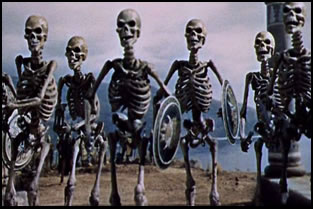 The first discussion was centered on the character of reanimated skeletons, and how, it seems, that these skeletons are all entertainers. It often seems that these skeletons get reanimated because of a greedy lust for life. Think about it: reanimated skeletons are constantly presented as singing, playing the xylophone and dancing rickety, herky-jerky dances in order to scare the dickens out of janitors or trespassers. It occurs to me as I type this that some of them are warriors, but even then they always seem to be delighted about the fighting, like it's a well-rehearsed performance. Not to mention the fact that they always lose. I think they're not so much warriors as they're like the team the Harlem Globetrotters play. And it's such an honor to share the battleground with Achilles! We also questioned whether skletons would ride a bicycle.
We all know they like motorcycles, but a bicycle is a different story. Tara contended that the ones who rode motorcycles were the skeletons we always got to see, in other words, the more successful skeletons, whereas a "normal" skeleton wouldn't be able to afford it. I argued that a bicycle might be too dangerous for a skeleton because, if it were to fall, it would explode into a million pieces. She rightly countered that the same is true for a motorcycle. I conceded this point and we shifted the discussion to where a skeleton might like to live. We decided on basement apartments. 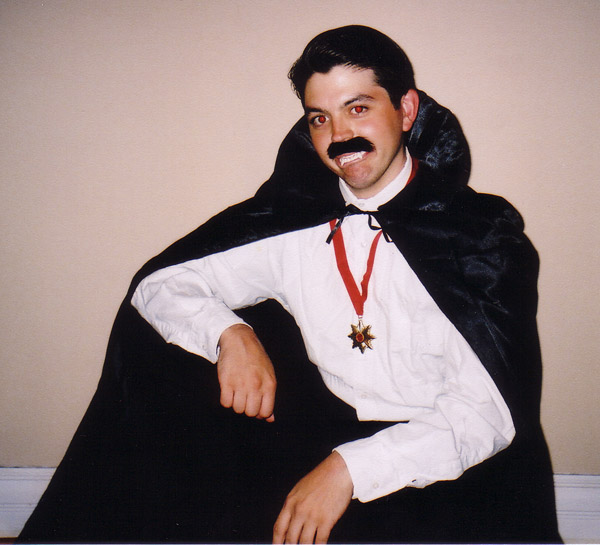
The second discussion was a hotly debated topic as to who would win in a fight between a dracula and a wolf-man. I originally sided with the wolf man because draculas are far too prissy and a wolf-man's raw power would be the decisive factor. However, this morning I remembered that draculas have dominion over some beasts and so would probably have some degree of mind control over the wolf-man. I think we left it that neither one would be able to kill the other, so the end result would be that the two would simply fuck each other up.
Thoughts?
Thursday, December 01, 2005
Day 62: King of New York
Notable for a fun, over-the-top performance by Laurence "Larry" Fishburne, a cool, indulgent performance by Christopher Walken, and some hyperslick cinematography, King of New York is not quite good, but it is an authentic greasy diner at 3 a.m kind-of. junk food viewing experience that is often alluring. The tone of the film shows what a film would be like if Michael Mann, Ridley Scott, and Brian DePalma were fused together in a freaky telepod accident, a three-way Brundlefly of slick, pretty cinematics and unfulfilled arty aspirations, expressed through heartfelt close-ups of violence and tits; a Brundlefly named Abel Ferrara. It's not quite as good as it sounds though. If this were a more focused character drama or a go-for-broke, by the numbers genre film, it would have been awesome, but the movie straddles both worlds unsuccessfully, leading to a pretty, yet scattershot mush.
Walken plays Frank White, a New York drug kingpin returning home from a lengthy stay in prison. He's anxious to reclaim the city's crime scene from those he feels are unworthy to carry the torch, motivated by a newfound sense of altruism. White's big plan is to fund a hospital in a poor neighborhood with his drug money, and he wouldn't mind taking out the other drug lords who, according to him, unnecessarily exploit people while he does this. Meanwhile, a group of cops led by David Caruso steam and fume over his release, lament his wealth from a life of crime while they barely make do with their miniscule salaries.
A wonderful moment, albeit one of easy sentiment, occurs about three-fourths of the way into the movie. Walken, in a dingy underground tunnel, orders the death of the squealer. He walks to the exit of the tunnel and stops, staring out at the city he loves. The camera stays behind, observing him from within. It's a beautiful moment, capturing the way the lifestyle Walken is leading holds him back from realizing his dreams for New York. It's the stuff of every gangster movie in memory: the desire to leave a corrupt and failed system to do some real good, but being unable to do so. It's quiet, poignant and thoughtful, and the movie could do with some more of this kind-of filmmaking if it had anything it wanted to say about White's misplace altruism.
But, then there's all the shooting. The genre beats, the shoot-outs, and the squib explosions are all accomplished bits of filmmaking in their own right. I admired the way some of the death scenes in the movie were played by the actors as extensions of their characters, not simply "I am dead now!" moments where they'd get shot out of the plot. And I particularly enjoyed the way two out-of-focus background bums watched a climactic shootout. A long car chase with shooting on the wet, rainy (and bridgey) streets of New York is well handled too.
So what's wrong here? Frankly, Walken dances a little too much (blasphemy, I know. It should be noted, though, that there's a classic buildup to a Walken monologue near the end.), the script focuses on certain story beats for much longer periods of time than they deserve, and the film's conclusion is a muddled riff on the reflexive nature of power and violence. You know, the old live by the sword, die by the zzzzzzz, huh, what? Oh yeah. The editing is also all over the place; the movie never really finds a narrative a groove until sometime in the third act and this groove is quickly discarded. So, despite the excessive and vulgar tawdriness at times, King of New York is not great, kinda fun, and better than McBain.
Wednesday, November 30, 2005
Day 61: The Leopard
There's a certain shame that comes from not understanding the context about which a story is told, a shame that sometimes inspires a reticence to admit the ignorance I have. The Leopard poked at my ignorance over and over during its running time, detailing events that, to me, might as well have been about ancient Martian political insurrections and aristocracies run amok. I found this excruciating.
The film is, on its surface, about events in Italian history, specifically events in Sicily (you know, the place with penetratingly sweet sherberts), and I'm still not entirely sure I understand the historical aspects of the film (the shame). My loss. The events depicted are gorgeous, beautifully shot and thick with period pageantry. This is so emphasized in the opening, with depictions of a wealthy, aristocratic family run by Burt Lancaster and some revolutionary fighting in the streets, that I feared I might be in for an Italian version of Gone with the Wind, only without the context to get why this terrible war was being fought in the first place. Not so.
What The Leopard is about is the passing of one age to the other, from monarchy steeped in beautiful, yet restrictive, traditions, to the ugly rabble and freedom of a people-run state. This passing is personified by Burt Lancaster as an aging prince, forced by circumstances to compromise his principles in order to preserve his way of life. His era and its way of dealing with power are contrasted sharply by Paola Stoppa as a stumbling, ill-mannered rube, a man lucky enough to have acquired such wealth as to be a force to reckon with in this new world.
I've written about how this movie angered me on first viewing. Not having the proper context surely played a part in that. If I were a history buff, I'm sure I'd have been delighted to see history written with such lightning. Instead, I was confused, displaced, and irritated that the movie didn't help me along by setting up the historical context (I can be a dumb American too) more clearly. But even with this crankiness, there was no mistaking the brilliance of the ballroom sequence in this film. It goes on and on as people dance and Lancaster stomps about, tired, worn, and saddened by the death of his way of life. It's superb on every level and hits its height when the old prince dances with Claudia Cardinale, a dance that gives him one last chance to be a true dashing prince and not the withered old man he really is.
The Leopard will stay with me for the rest of my life, this much is certain (and not just for letting me know about the penetrating sweetness of certain sherberts). The images in it are stark, sharp reminders of how beautiful cinema can be, and the weary, oppressive tone is a brilliant, grim counterpoint to this beauty. Despite my first impressions, I'm beginning to think it's one of the better movies about aging and dying, making the personal aspects of aging political and the political aspects of worn-out regimes personal. Still, I do wish to see it again, preferably in five or ten years so that the first impression will have faded some. Maybe it's just an indulgent, pretentious stew after all. I can't say right now. I'm still in love with the last shot of the film.
Now is that Gratitude? Or is it really love?
So, after reading the comments on yesterday's post, I've decided to set up a spinoff blog at the end of the year. I imagine it will be more "bloggish" and will probably detail my aborted attempt to get into shape with such clarity and detail as to add, by its existence alone, another five pounds to my ever engorging waistline (are you with me ladies?). I'll be sure to post a link when it's available.
Thought this Pinky Violence collection thing looked interesting.
last night, I watched The Leopard. It was one of those rare occasions where I feel as if I need to watch the whole thing all over again, no small feat. It's not that I didn't "get it" or that I was confused by it, per se, but the movie ended in such a way that I realized it had been a completely different movie than I thought it was while I was watching it. Watching this three-hour movie was sometimes a chore. For the first hour and a half I was angry at it, frustrated by the giddy attention to period detail. By the 2 hour mark, I was even angrier, since the movie seemed determined to be as free of direction as some misguided people apparently think L'Avventura is.
At about two hours and eight minutes (if I remember correctly), an unintentionally funny line made it impossible for me to continue for at least five minutes. The main character is talking about the character of Sicilians, how it's so lugubrious and yet sensual... as examples he provides knifings, shootings, and then offers "the penetrating sweetness of our sherberts..." Wow. How bizarre.
Anyway, the movie ended and I was suddenly taken with it, even though for most of its running time I was angry, angry, angry. When this happens, it's usually a signal to me that I need to watch it again, if only to be sure that my anger was justified. Sometimes movies just end well, despite middling beginnings, but other times, I've just been completely wrong about what the movie was doing the whole time and my anger is just that of a spoiled brat not getting what he wants from his entertainment (I'm sorry about what I said, Rushmore) But then the idea of sitting through something that made me as furious as parts of this movie did isn't exactly a pleasant thought. Of course, the notion of being able to appreciate something beyond my preconceptions is. Hmm, does this count as a review?


